Cancel
Start searching

This search is based on elasticsearch and can look through several thousand pages in miliseconds.
Learn more

This year’s EuroBSDcontook place in Paris from September 21–24. Since my talk on the FreeBSD-based architecture of our proServer had been accepted, I had the pleasure of attending the conference this year not only as a participant but also as a speaker. I was accompanied by my colleague Joachim Mathes, who developed key parts of the proServer automation within our team.
Our first day was filled with a full-day tutorial led byGeorge Neville-Neil. In his usual witty and entertaining style, George introduced us to DTrace—a diagnostic framework ported from Solaris that makes it possible to “take a close look” at applications in a way never seen before, without significantly impacting the system as a whole. Shortly after the conference, we successfully applied this new knowledge to identify a performance bottleneck in a complex TYPO3 application. DTrace will now be a standard part of our team’s toolkit.
All materials are available on GitHub under an open-source license:https://github.com/teachbsd/course
In his unconventional keynote,Thomas Porninshed light on the dynamics within development teams by drawing a comparison with the Trojan Krieg as described in Homer’s *Iliad*. Achilles, the invincible hero, embodies the exceptionally talented developer, while the conflict between Achilles and Agamemnon represents a management failure on Agamemnon’s part.
The bottom line: it’s easier to manage a team without a hero. But then you lose the war.
Olivier Cochard-Labbédemonstrated the steps required to implement a FreeBSD-based router on standard server hardware that achieves 10 Gbit/s forwarding throughput. Since our current infrastructure is challenged less by throughput and more by the memory requirements of the global routing table, migrating our BGP to a software router is an interesting approach that we will continue to explore.
In my own presentation, I was able to explain the challenges we’ve faced in hosting in the recent past and the changes we’ve implemented since then compared to our “NanoBSD” architecture, which we introduced in 2010. From the hosting provider’s perspective, proServer offers many of the desired features of a “private cloud” product, but to the customer, it appears as a traditional root server. For applications that require such a platform, this is an invaluable advantage over pure container solutions, which almost always require a specially adapted application architecture.
Following the well-received presentation to a full house, a lively and insightful discussion ensued.
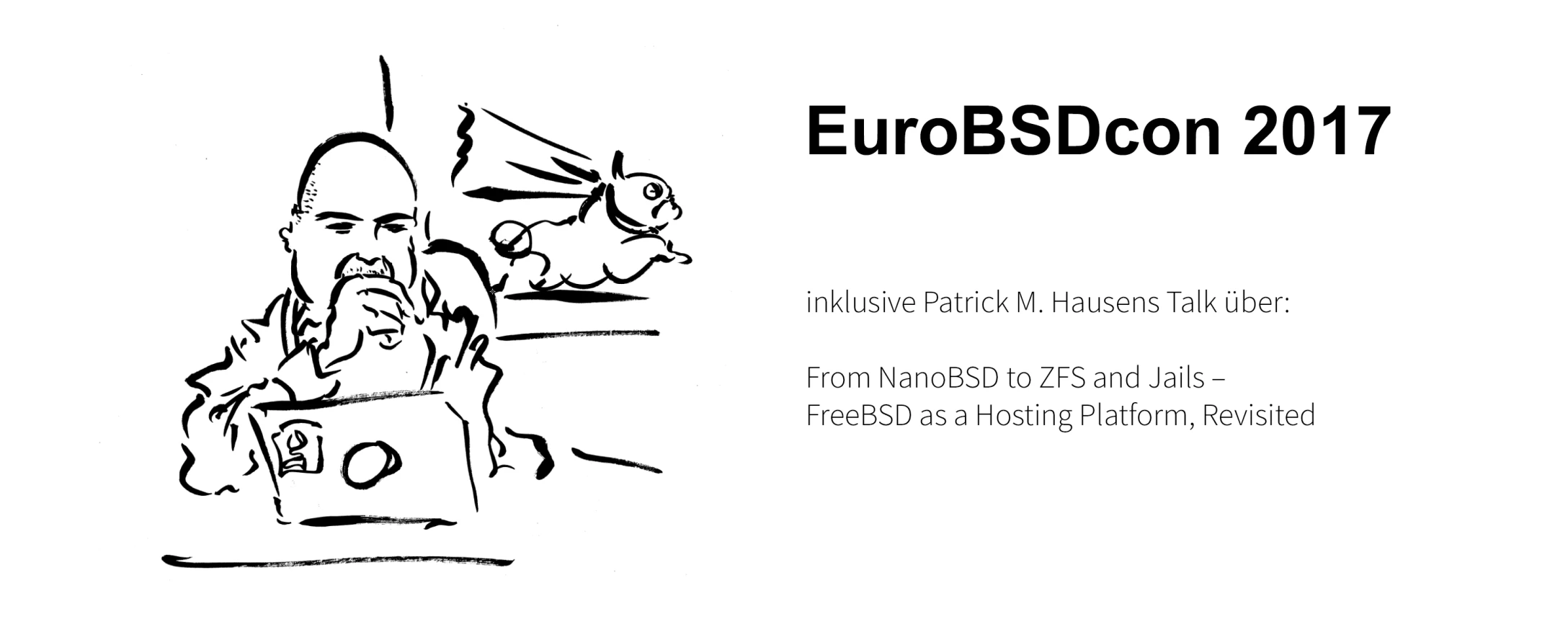
To lighten the mood, the organizers had hired a caricaturist, who actually sat in on every single presentation and drew a caricature of the speaker.
Immediately after the presentation, I hosted a “Birds of a Feather” session—a gathering and open discussion among like-minded individuals on a specific topic. In this case, the topic was high-availability storage systems based on open source, specifically FreeBSD. Here, too, there was a great deal of interest, and we were able to engage in an in-depth discussion. It was particularly enjoyable and insightful to connect with several developers from iXsystems who were in attendance—the company behind FreeNAS and its commercial counterpart, TrueNAS.
The conference dinner—commonly referred to as a “social event”—took place that evening on a boat on the Seine. The gods were smiling down on us and rewarded us for our day’s work with a balmy late-summer evening and fantastic views of Paris’s landmarks.
Mariusz Zaborskireported on his experiences adapting parts of the FreeBSD base system toCapsicum. Capsicum is a capability framework—that is, a way to run applications separately from one another in their own "sandboxes." Capsicum is merely the latest and most advancedin a series of projectsrelated to “Mandatory Access Control.” You may even use one of them— TrustedBSD—every day, certainly if you own an iPhone or iPad.
Ed Schoutenargued against attempting to portDockerto FreeBSD. He said this was a race that couldn't be won, since they would always lag behind the Linux implementation in terms of compatibility, features, and stability. Quite apart from the question of what benefits one would actually gain, one would be running the solution in an otherwise identical form on a different platform.
He advocated for a pragmatic approach and presented his project, in which he uses the well-known cluster frameworkKubernetesto orchestrate highly encapsulated microservices on FreeBSD with Kubernetes. This solution offers more—and different—features than Docker when it comes to isolating individual services, making it potentially interesting for certain applications. Ed is looking for dedicated contributors at.
In a sense, as a supplement to our tutorial, George provided an overview in his presentation of the current status of the FreeBSD port of DTrace and an outlook on future development across all supported operating systems. He focused in particular on the possibilities of using DTrace in computer science education within the “Operating Systems” course. Studying source code is one thing; being able to observe a running system directly at work is quite another. This is an approach thatRichard Stevenshad already adopted 20 years ago to help his readers understand how the TCP/IP protocols work.
To wrap things up,Julien SimonandNicolas Davidgave us a demonstration of how to deploy and run FreeBSD in the Amazon Cloud (AWS). Although the presentation veered a bit into an Amazon sales pitch, it was still an interesting introduction. Offering the proServer platform not only in our own data center but also on the platforms of major cloud providers is a stated goal of our team. One possible use case, for example, is operating application servers distributed worldwide—something we wouldn’t be able to offer in this way with traditional hosting.
Unfortunately, we had to missBrendan Gregg’s closing keynote because the TGV back to Karlsruhe was waiting for us. Brendan is the author of books on DTrace and system performance. Not surprisingly, the analysis of performance bottlenecks was also the topic of his presentation, which focused on FreeBSD.
In addition to the presentations, there were, as always, plenty of opportunities for networking and sharing experiences. I was especially pleased to finally meet Benedict Reuschling and Allan Jude in person after having had the honor and pleasure of interviewing them for the “BSD Now” podcast back in May. All in all, it was a very successful and informative conference—with a new record number of attendees.