Cancel
Start searching

This search is based on elasticsearch and can look through several thousand pages in miliseconds.
Learn more
It's true: we design, develop and support complex enterprise solutions.
It is also true that we are looking for reinforcements. Software developers and programmers who want to become part of the punkt.de team and grow with us. So we thought it was high time we took a look behind the scenes: What is our method of software development all about? How do we work?
For us, software development means Scrum. We have been using agile development for two years now. Of course, it's no big deal to understand the different roles of Product Owner, ScrumMaster and developer teams as well as the Scrum process as a whole in theory. But internalizing it and putting it into practice every day remains a challenge. At least if, like us, you have one goal: to continuously work on the development process and thereby get better and better and better ..
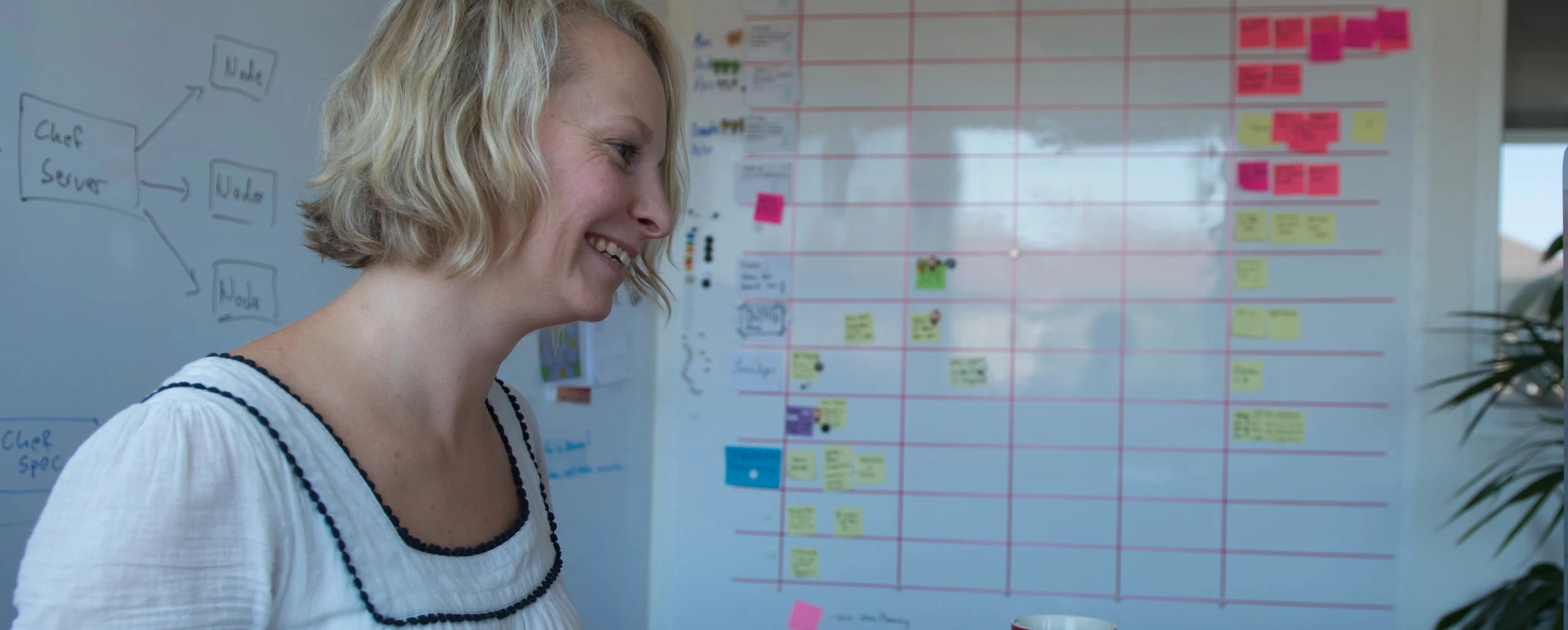
We are team players. We don't just write that in our job advertisements because it sounds so nice, we mean it. Working in fixed teams is perhaps the clearest example of how software development with Scrum turns familiar working methods on their head. Meetings, for example, are on our agenda - literally, by the way. Consultations with each other and regular exchanges are important in order to function as a team. That's why our working day begins with the daily stand-up, a quarter-hour team meeting in which all team members synchronize the status of development with each other and discuss which tasks are pending and who will take them on. From the outside, the meeting culture quickly looks like a waste of time, but in fact the exact opposite is the case: as a Scrum team, we have far-reaching obligations, but also a great deal of creative freedom. In short: working together makes all the difference. Communication is therefore a key success factor in our software development, both among ourselves and with our customers.
As a team, we bear responsibility for the project, define our work processes and deadlines independently and must therefore always be able to rely on each other. A simple example of how this can be felt on a small scale in everyday life: Vacation is not approved from above, "by the boss", but vacation planning is negotiated within the team. This idea that the team forms a "functional unit" ultimately also has very practical advantages for each and every one of us. For example, difficult tasks that developers used to be left alone with are much easier and quicker to tackle in a team because several people contribute their approach to a solution and feel equally responsible for its success. Last but not least, taking responsibility in Scrum also means being courageous. Alongside respect, openness, commitment and focus, courage is one of the agile core values. Two examples: It takes courage to be open with my colleagues, perhaps even to face their criticism. It also takes courage to advise a customer well and to give them our assessment if we think that their requirement is not the best solution. But the fact that our customers really appreciate us for this ultimately only proves one thing: the decision to use Scrum has paid off for all of us ...