Cancel
Start searching

This search is based on elasticsearch and can look through several thousand pages in miliseconds.
Learn more
READING TIME: APPROX. 3 MINUTES
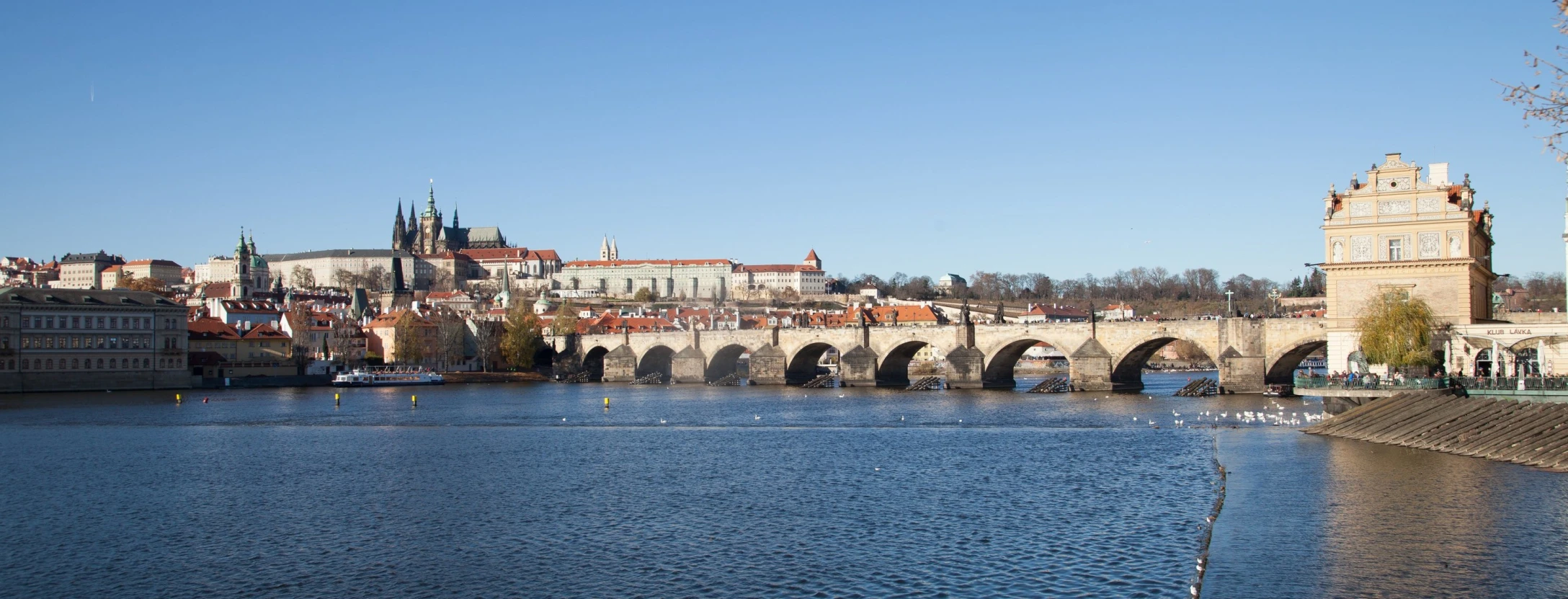
Working according to agile principles and Scrum has been a long-standing tradition at punkt.de for several years now. We expected to gain new insights from the presentations and the experiences of other participants during our visit to the heart of the movement—the Global Scrum Gathering in Prague. We were by no means disappointed!
Niels Pflaeging delivered the exciting—and quite sensational—opening keynote on the topic “Organize for Complexity.” He argued that, since the 1970s, management has been nothing more than a zombie—killed by the complexity of corporate structures in the changing industrial age. In today’s information age, we need structures in which the thinkers are also the doers.
He also presented Douglas McGregor’s X-Y Theory, which describes Theory X people—who are directed, seek security, and are strictly controlled—and Theory Y people—who are intrinsically motivated and responsible. He concludes that Theory X people do not exist. People’s behavior is determined solely by their environment—in this case, by corporate culture and structure.
Corporate structures that foster Theory-Y employees do not necessarily have to be flat—flat is the wrong image—they should rather be “peach-shaped.” With an outer periphery oriented toward the customer and a core that supports the periphery. It depends on the role and the specific situation as to who sees themselves as part of the core or part of the periphery.
Using the image of the giraffe—the animal with the biggest heart—Ralph Miarka began his session, “From Nonviolent Communication to Potential-Focused Communication,” by once again introducing the four steps of nonviolent communication. In his experience, conversations about problems create new problems, while conversations about solutions also generate them. The four steps of potential-focused communication emerged from this idea.
LeSS—Large Scale Scrum —is a framework for scaling Scrum and agile development across multiple parallel teams for large projects. In his highly entertaining talk titled “More with Less,” Bas Vodde presented the principles of LeSS. While Bas defines scaling as the division of a central backlog among 100 parallel teams, many of the principles presented can easily be applied to the distribution of a project on our scale, with three teams. It is important not to divide the development teams according to specific roles such as “ Backend ” or “Frontend,” but rather to have multiple cross-functional teams work on individual features. (The customer doesn’t want a “Frontend” feature or a “ Backend ” feature—they simply want a feature.)
Dependencies between the teams alone aren’t the problem—rather, the problem is temporal asynchrony. This refers to the following situation: Team A wants to start a task but needs preliminary work from Team B. To avoid downtime, Team A begins a new task. Meanwhile, Team B finishes its work but receives no feedback from Team A, which is now occupied with something else. With many teams working in parallel, this leads to significant time lags, and the delivery chain grinds to a halt.
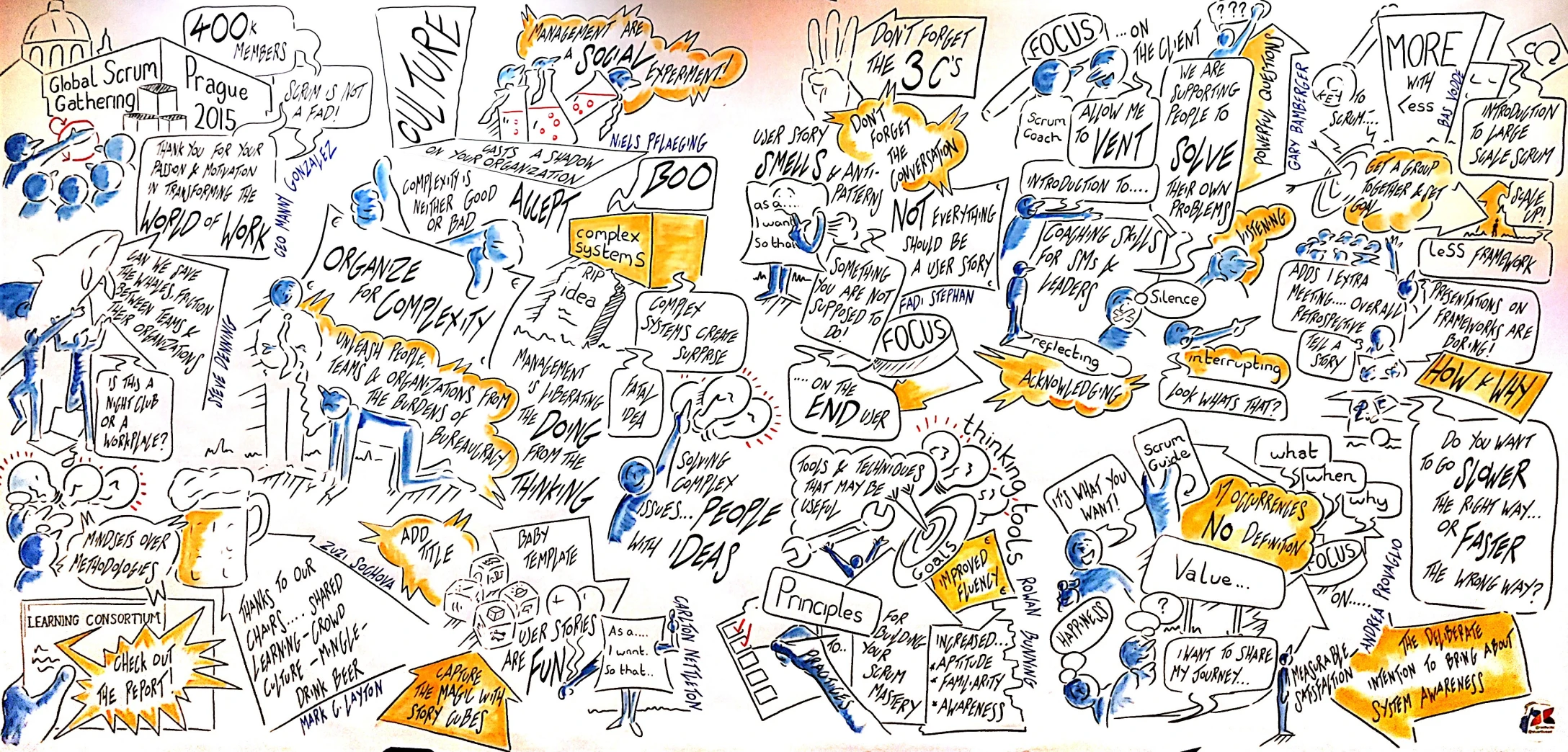
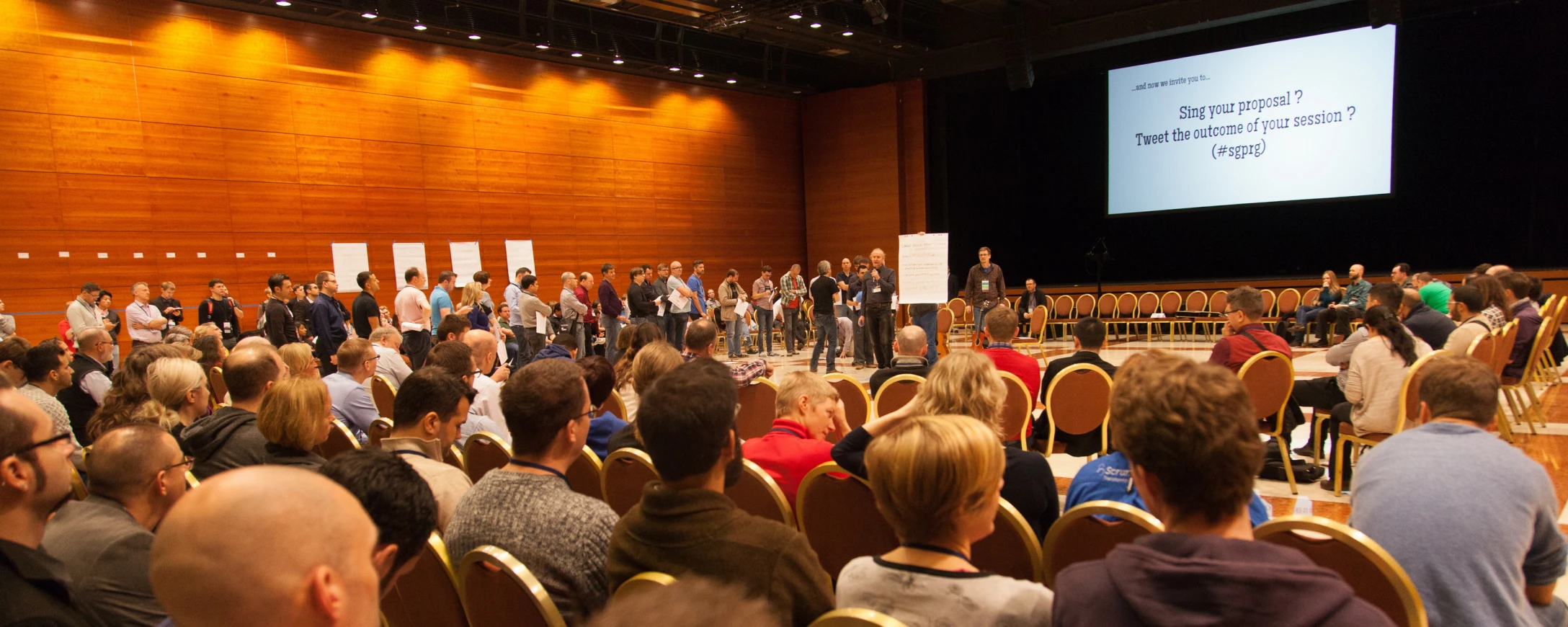
After two days packed with sessions, the third day was entirely dedicated to Open Space, a conference format that’s now quite well-established—but an Open Space with 600 participants and 15 parallel sessions across three time slots was a completely new experience for me. As a special challenge, the session leaders were asked to sing or dance their session proposals—and they rose to the challenge with enthusiasm and often with a touch of humor. Faced with so many interesting-sounding sessions, I had a hard time deciding, but ultimately chose “Artistry Mastery” by @Stuartliveart, who also captured the essence of all the event’s talks in graphic form on large posters. In “Improv Games (with Hats),” Paul Godard demonstrated how exercises from theater education can also be applied to work in agile teams, such as during retrospectives.
Between the individual sessions—and, of course, at the “Monday Mingle,” the social event on Monday—there were also plenty of opportunities to connect with the other fascinating participants from around the world and discuss various topics and questions. All in all, it was a very well-rounded and enriching event, and I hope it won’t be my last Global Scrum Gathering.