Cancel
Start searching

This search is based on elasticsearch and can look through several thousand pages in miliseconds.
Learn more
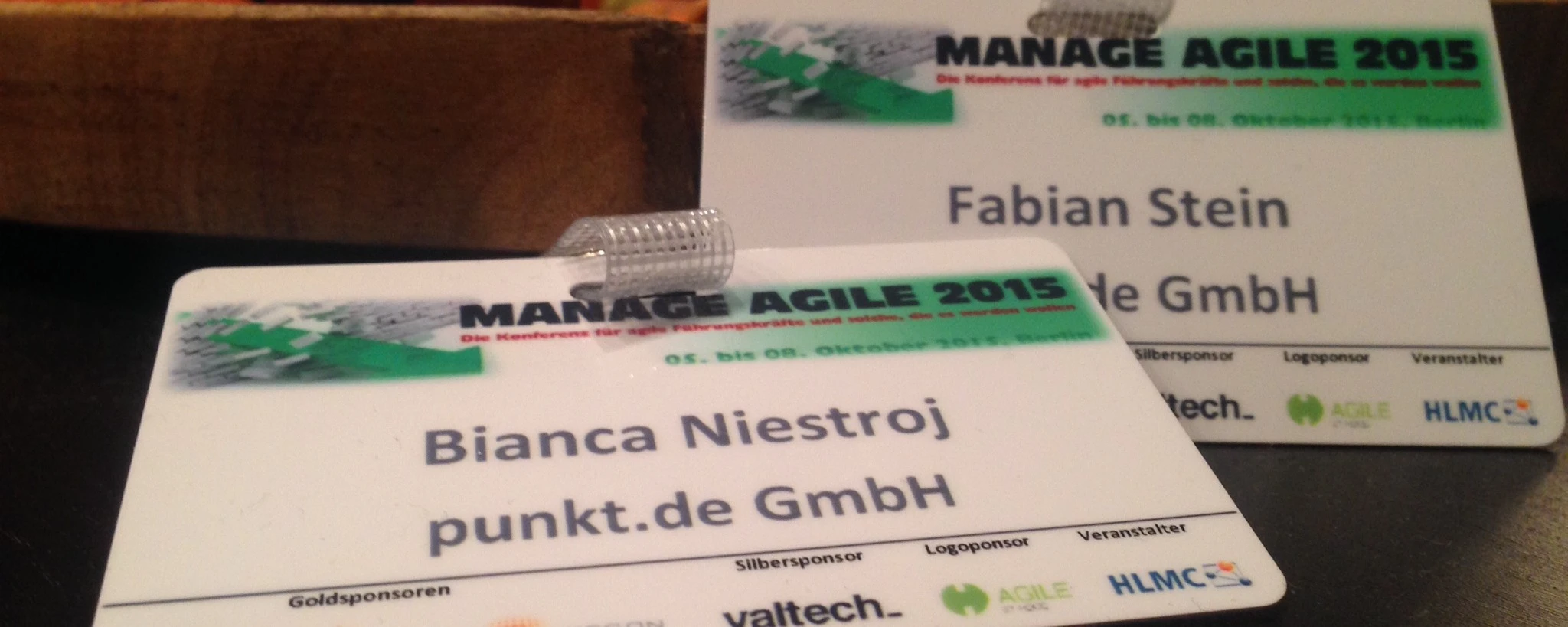
At the fourth Manage Agile conference in Berlin-Brandenburg, which took place from October 5 to 8, 2015, a full program of presentations and workshops was offered, which my colleague Fabian Stein and I attended.
I’d like to mention right off the bat that the conference served as confirmation for us of what we’ve been doing over the past few months to become even more agile. Unfortunately, however, this also means that the conference provided little added value for us, because much of what was discussed there—including the ideas and suggestions—aligns with what we’re already doing or have implemented, and what we plan to do in the future. Nevertheless, I don’t want to withhold my personalkey takeawaysfrom you (listed in no particular order):
Even if the IT department thinks we’re now “the cool kids on the block” because we’re agile—as Dr. Andrea Tomasini from agile42 so aptly put it on the second day of the conference—he went on to emphasize that Toyota discovered this principle for itself nearly 100 years ago and called it “Continuous Improvement.”
Several speakers elaborated on this statement from different perspectives or offered tips on how to achieve this more easily. For example, by defining values and/or rules for how decisions should be made within the company. Or that during transition phases intended to lead to greater agility, it is important to introduce new processes quickly so that two processes do not coexist, thereby producing a great deal of “waste”—for example, because people are still operating according to the old process (which is undesirable). hr pioneers also pointed out that 100 percent self-organization of development teams can lead to demotivation or be counterproductive, because they suddenly have to shoulder too much responsibility, even though they may actually “just” want to focus on development. That’s why the HR Pioneers advocate not burdening the teams with all the responsibility, but rather relieving them of certain tasks—such as organizational ones.
A strategy of wanting to be “agile” must fit the company—that is, employees and management must want it and should stand behind it. hr pioneers further expanded on this point by noting that there are different “levels of maturity among agile companies,” and a company can only become more agile if the agile mindset of the people working there is greater than the “agile level” the company has reached so far. The diagram shown in this context reminded me of an avocado because of its colors and shape, which is why I’d like to call this model the “Agile Avocado” here. Furthermore, as some speakers mentioned in passing, one should never lose sight of the guiding principles of the “Agile Manifesto.”
Agile companies—or those that aspire to become agile—should strive to be as transparent as possible in as many areas as possible, such as corporate strategy, order backlog, and in-house expertise, not only toward customers but, above all, toward their employees.
As I mentioned at the beginning, I didn’t gain many new insights for our company, so I can’t give a clear “yes” to the conference. In my opinion, contrary to its motto, “The conference for agile leaders and those who want to become one,” the conference is more suited for leaders who aren’t yet agile—or who don’t act that way—and who can use the conference as a good source of information with many experienced experts.