Cancel
Start searching

This search is based on elasticsearch and can look through several thousand pages in miliseconds.
Learn more
Whether in a project or for your company’s own infrastructure, the role of DevOps is becoming increasingly important!
The interaction between software and infrastructure is essential to the success of your project or your company.
Selecting the right infrastructure and tools, and configuring them appropriately to ensure your software meets security and quality standards, requires expertise and experience.
With our specialists, you’ll benefit from our experience through consulting and implementation!

Our specialists will guide you from start to finish and support you with their many years of experience and expertise. Even after successful implementation, our specialists will continue to be there for you to provide ongoing operational support, make adjustments, promote further development, and offer training. Our specialists offer you the following:
With our DevOps specialists, you can leverage our extensive expertise in the integration of software development and infrastructure for your project or company.
Our specialists have extensive experience with various software architectures and development processes. As a hosting provider, we also bring a wealth of expertise in infrastructure architecture to the table.
You can decide whether you’d like us to simply advise you or have our specialists get directly involved in your project. The advantage for you is that you don’t have to build up or maintain your own DevOps resources within your company.
It’s important to emphasize that the code (IaC) developed for you belongs to you. You’re free to decide whether you’d like to continue working with us long-term or build up internal resources. We’ll support you in this process through documentation and training.
Depending on the nature of your project, we’d be happy to advise you on the appropriate infrastructure. We offer solutions across the entire spectrum, from smaller environments such as individual VMs to highly complex server infrastructures in your data center or in the cloud. If you already have an infrastructure in place, we’ll gladly take over its operation and further development for you.
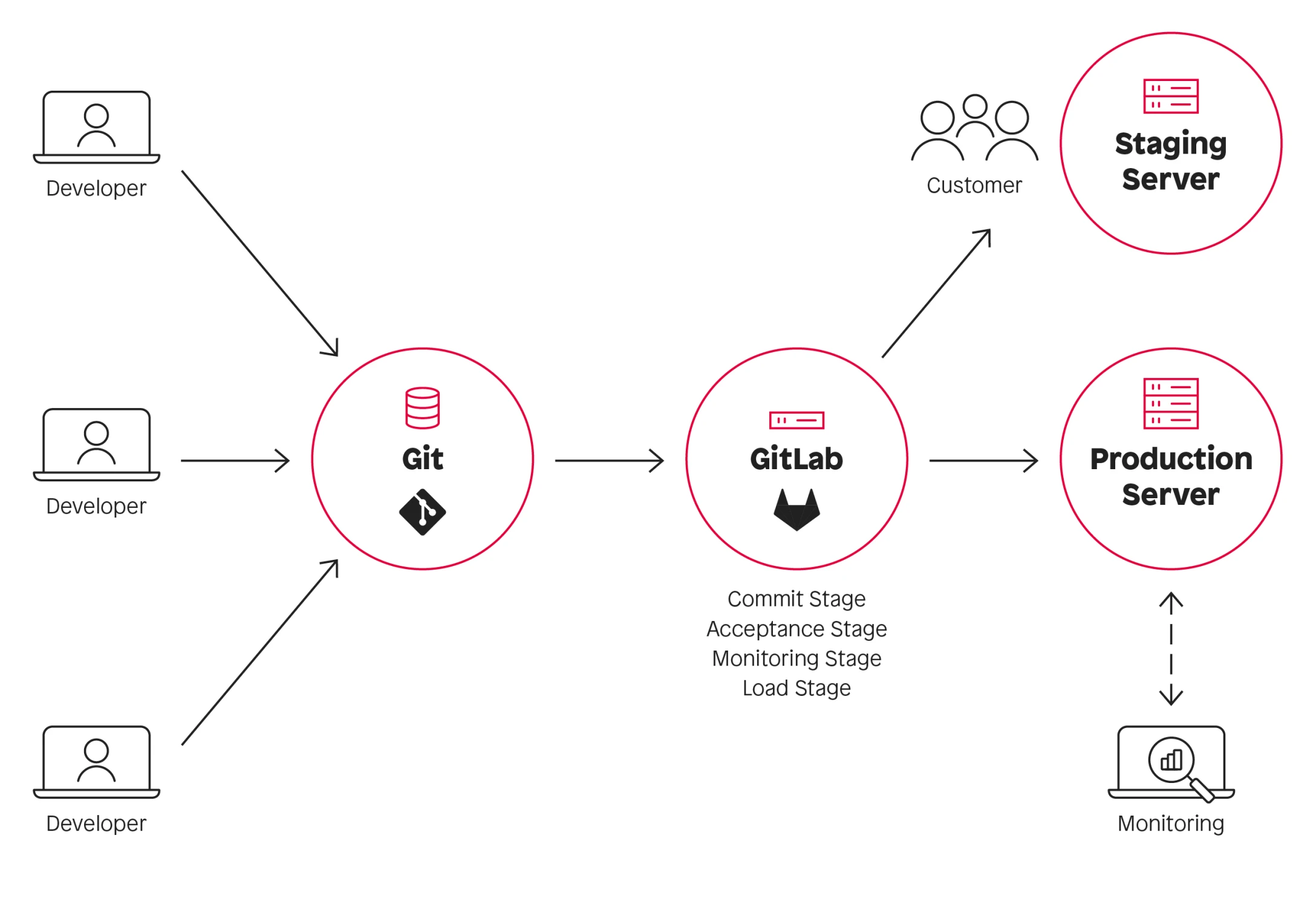
We place a high priority on standardizing code quality (CI & CD) and security. In addition to automated testing and monitoring, we also keep a close eye on your domain/infrastructure and adapt it to various threat scenarios.
If you have any questions about our services or the individual topics, please feel free to contact us. We’ve also explained these terms in more detail for you in the “DevOps in a nutshell” section.
Continuous Integration (CI) and Continuous Delivery (CD) are practices in the fields of software development and DevOps that aim to optimize the development and deployment process.
Continuous Integration (CI):
Continuous Delivery (CD):
In summary, CI and CD promote automation, consistency, and efficiency in the software development lifecycle, enabling development teams to become more agile and deliver high-quality software faster and more reliably.
Microservices are an architectural approach to developing software applications in which an application is broken down into smaller, independent services.
Each of these services, also known as microservices, performs a specific function and can be developed, implemented, scaled, and updated independently of one another. This decentralized structure enables greater agility, flexibility, and scalability in software development, as changes to one microservice do not affect other parts of the application.
By using microservices, development teams can respond more quickly to changes, simplify maintenance, and improve the application’s overall reliability and scalability.
Infrastructure as Code (IaC) is a method used in software development and DevOps in which the infrastructure required to deploy and run applications is described and managed using dedicated scripts or configuration definitions.
Instead of using manual processes or graphical user interfaces, the infrastructure is defined using code that is stored and managed in version control systems.
By using IaC, DevOps teams can automate infrastructure, ensure repeatable and consistent deployments, and respond more quickly to changes.
This enables more efficient resource management, improved scalability, and the ability to treat infrastructure like application code, thereby bridging the gap between development and operations (Ops). IaC contributes to the agility, security, and reliability of IT infrastructures.
Service monitoring refers to the proactive monitoring and analysis of IT services to ensure they operate efficiently and reliably. In the DevOps world, service monitoring plays a critical role in ensuring the availability, performance, and health of applications and services. Here are some key aspects:
Service monitoring helps ensure the availability, reliability, and performance of IT services, which is crucial for guaranteeing a positive user experience and minimizing downtime.
Automated testing is a practice in software development and the DevOps approach that involves using specialized software tools to perform repeatable and predictable tests on software applications. The purpose of automated testing is to ensure the quality and stability of software during the development process.
In summary, automated testing involves:
Automated tests help improve software quality, shorten development time, and ensure the reliability of applications by providing an efficient way to check software for bugs and unintended behavior.
Agile software development is an iterative and collaborative approach to software development that aims to respond flexibly to changes, better meet customer needs, and achieve higher productivity in the development process. Here are the core principles of agile software development:
Agile software development promotes an adaptive and responsive approach that is particularly well-suited for projects where requirements can change rapidly. Agile methods such as Scrum or Kanban are frequently used in DevOps environments to enable efficient software development and deployment.