Cancel
Start searching

This search is based on elasticsearch and can look through several thousand pages in miliseconds.
Learn more
What was important to me was that this wasn’t just about new business areas or new fields of activity for me, but first and foremost about the question: What does the Internet mean for our society, and what challenges will we face in the coming years?
Fortunately, a few colleagues shared this interest, so Daniel Lienert, Jürgen Egeling, and Florian Franke from our partner agency made in set off for Berlin.
My expectations were by no means disappointed. Coverage of re:publica is, after all, increasingly divided. Some describe it as a “reunion of a media elite” that is increasingly losing sight of society. Others celebrate this very reunion as groundbreaking for the reality of the media landscape in Germany.
After my first re:publica, I can understand both perspectives and am firmly convinced that both fall significantly short. I also can’t relate to the somewhat reproachful tweet from thousands of smartphones: “The most important conversations only take place in the courtyard anyway.” Just as every good conversation at a party takes place in the kitchen, every important conversation at a conference happens among people in the courtyard. It doesn’t matter whether it’s a management, technology, or media conference.
But what was there to take away in terms of content? Well, first of all, the realization that if you wanted to learn about the big topics like Twitter, Snapchat, or viral marketing, it’s worth lining up early for a talk. Unfortunately, I wasn’t able to get into some of the talks I would have liked to see.
The day kicked off right away with the TTIP revelations, which I unfortunately couldn’t make it to in time. The first truly great talk I was able to catch, however, was Kati Krause’s (@katikrause) presentation on digital magazines and Slow Media. In particular, her call to have the courage to say less sometimes and to make sure to produce only brand-relevant content—that is, content that supports your own brand message—really resonated with me. This encouraged me to streamline the content strategy for our company blog even further.
As at any conference, there were unfortunately some less-than-stellar presentations, whether it was “Radio in Motion” or Deutsche Bahn’s talk on “Mobility re:loaded.” Some of the larger brands, in particular, couldn’t resist the opportunity to advertise on stage and clumsily presented their products or processes without offering any insights or explaining the challenges they’d encountered in the course of their work. Large corporations and government agencies, in particular, kept repeating phrases like: “Social media is easy—unless you’re a government agency” or “Being fast and agile is easy—unless you’re Deutsche Bahn.” In moments like these, I’m never sure whether I should feel sorry for them or whether they’re just patting themselves on the back for “managing” to be on Facebook despite everything.
Another woman on stage who made a strong impression on me was Kate Crawford (@katecrawford), who spoke about the Digital Terrorist Score. That was the first moment at re:publica that really caught my attention. This seems to be about more than just the latest hot trend online and the question of how I can increase my reach or find my target audience. This is about us. It’s about society and the question of what role digital realities play in it.
Ms. Crawford, of course, spoke about the obvious information that is collected and stored. But she also spoke about the somewhat less obvious aspects and the big question of how we can create increasingly convenient and intelligent services for ourselves without giving the world’s governments the ability to more easily influence and shape our opinions.
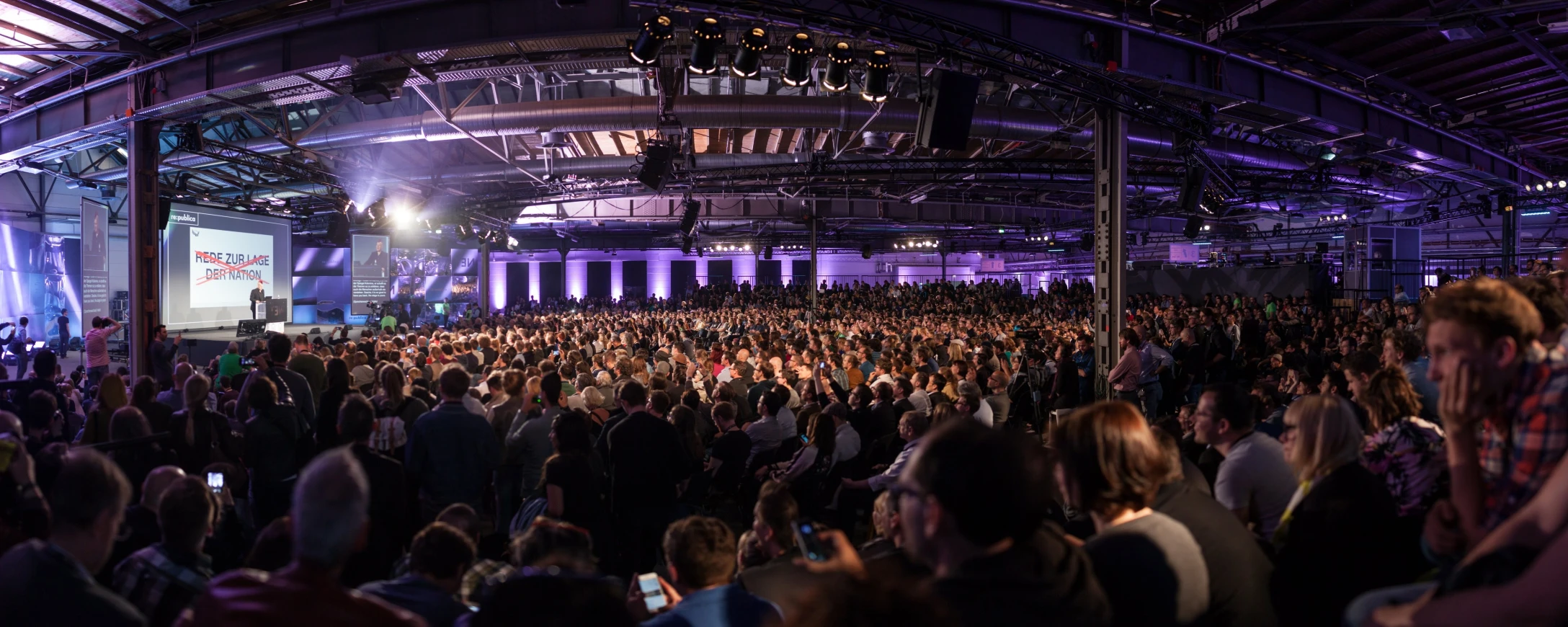
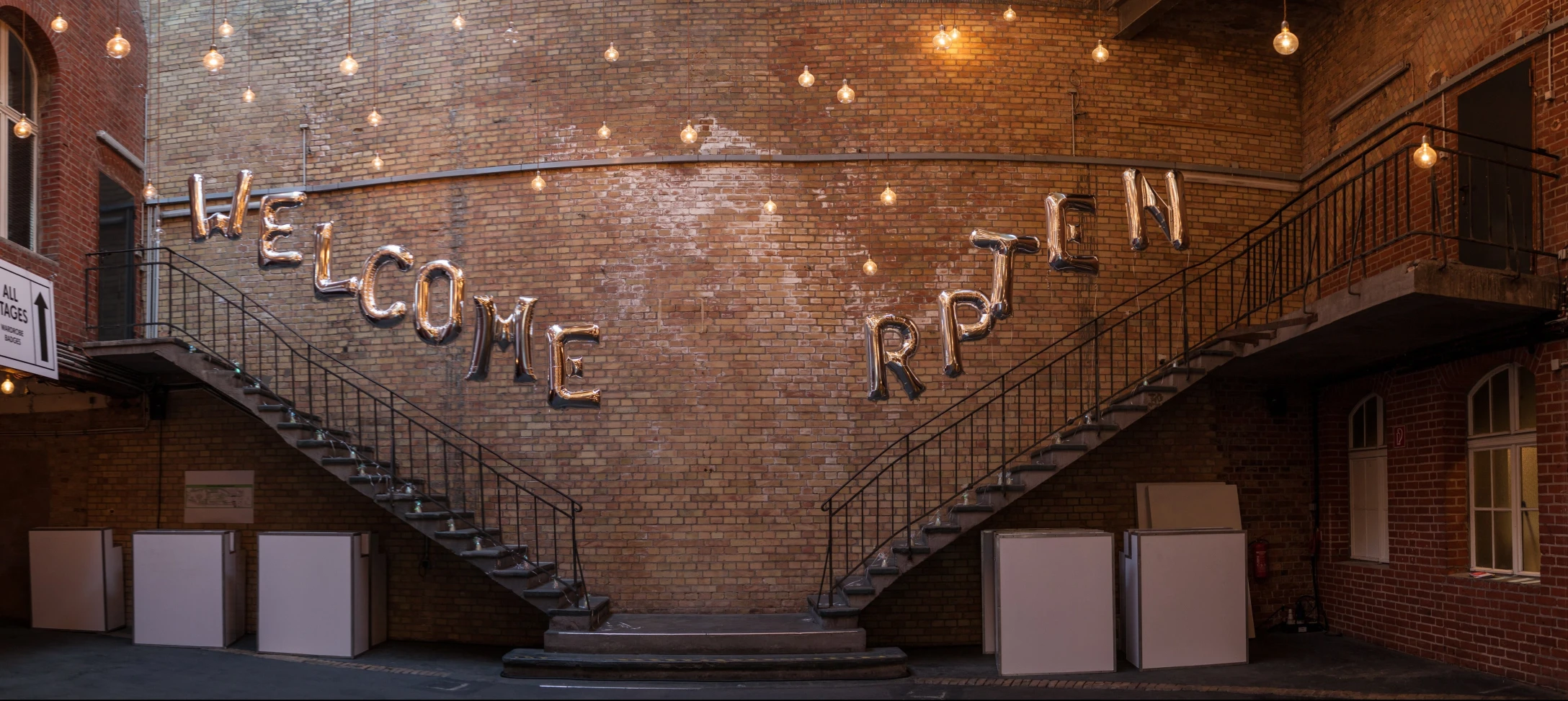
Like in previous years, re:publica took place at Station Berlin.
The first day wrapped up with the obligatory speech by Sascha Lobo. This, too, was a first for me. Of course, I knew him from various platforms—Elektrischer Reporter, Spiegel, etc.—but I’d never seen him in person before. The talk was interesting. I found the first part, in particular, surprisingly objective and engaging. The last 15–20 minutes, however, were so over-the-top that they somewhat ruined the overall impression. What remained was an interesting but by no means outstanding talk on why everything is terrible, yet why we should still keep fighting to make things better. I’m on board with that ;)
The second day began with my eagerly anticipated talk by the @heuteplus hosts. I’ll admit it here: I’m a total @heuteplus fanboy. The quality of the talk and the moderation alone was truly top-notch. The question of how to deal with such constant attention and criticism was also addressed in a truly personal and honest way. Since that panel, I’ve also been following them on Periscope and have realized that there are many use cases—especially within our communities—where Periscope would really be helpful.
To stay on the topic of my praise for the journalists’ presentations—especially those from public broadcasters—there was a fantastic panel on the “Junger Kanal” project. This is a collaboration between ARD and ZDF, which are working together to create online content for the 14–29 age group. Some interesting insights were shared there. Whether it was the question of which committees would need to be involved in such a process or the uncomfortable question of why “once again” there were three white men on stage and “what the situation is regarding diversity in the programming,” good answers were provided. We’re curious to see if they’ll actually follow through. The whole thing is set to launch in October.
The one topic that came up again and again at the conference was Snapchat—the new messaging service. I’ll admit I hadn’t really looked into the platform at all until then, but I also found the whole subject rather exhausting after the conference. Still, Snapchat in the context of new media is definitely worth a separate article of its own.
The presentation by Frauke Langguth (@frala), head of ARD Video Text, was surprisingly informative and funny. It’s a medium that, admittedly, even I would have thought had been dead for a long time. But the figures—4 million readers daily—tell a very different story. It was also interesting to learn about the possibilities teletext offers—ones I would never have imagined. Including Twitter integration on page 777 of ARD Teletext.
A great tweet on the topic came from Jean-Üw Fitz (@vergraemer), who wrote: “At some point, there’ll be a massive crash, and only teletext and cockroaches will be left.”
More by chance than anything else—and out of sheer convenience—I stayed put and was completely swept up in the story of a student who wanted to propose to his girlfriend during his professor’s lecture. But the plan fell through, and unfortunately, the woman was gone before it could happen. The whole thing was presented by Bernhard Pörksen, a professor of media studies in Tübingen, who made me briefly wonder whether I might want to study something in the field of media in Tübingen after all, if I were to hear such great lectures on the power of stories.
The highlight of my day was “Digital Quartett.” After five minutes, my chronic silliness made me want to just run away and finally grab a beer, but after the first guest, I finally got the hang of the format. If the part where you have to guess the guests were removed from the format—or at least shortened—I’d wonder why this isn’t broadcast on a linear channel. Both the host and the guests didn’t shy away from spontaneous and uncomfortable questions—or answers. Whether it was Rowan Barnett (@rowbar) from Twitter or the editors of Schluck magazine, everyone was interesting and gave fascinating interviews about their work.
On the last day, I was able to attend just one more presentation worth mentioning—from the state of Baden-Württemberg on its campaign “We Can Do Anything Except Speak Standard German.”
Both the speakers and the campaign itself offered interesting insights, as well as the realization that sometimes a campaign just needs a little bit of luck.
Unfortunately, this presentation marked my time at re:publica coming to an end. Now I’m sitting on the ICE back to Frankfurt and feel a little closer to the large German online community. My takeaway from this re:publica: The problems we face are, on many levels, the same as those we encounter in all other areas of society. Thanks to my wife, who is a special education teacher, I’ve gained insight into the challenges of education policy. Up until now, I’ve always hidden behind the fact that she has an influence on the children’s development, while I’m only concerned with the internet. But after re:publica, I’ve come to understand that it’s also—and especially—up to us in the media to shape perceptions and, thereby, the reality of society. Whether through technical solutions like encryption and other anonymization services, or through reporting on and exemplifying inclusion, diversity, and tolerance.
And isn’t that alone worth three days full of wonder? Many thanks to the “class” for taking me along. I’m looking forward to next year.
P.S.: Many thanks to Daniel Lienert (@dlienert) for the great photos.