Cancel
Start searching

This search is based on elasticsearch and can look through several thousand pages in miliseconds.
Learn more
For the first time this year, punkt.de participated as a partner company in the informatikBOGY program, and Damian and I were responsible for supervising the interns. The informatikBOGY program was launched by KIT in 2009 and is designed to introduce high school students to the various fields of computer science. To make this possible, partner companies are sought to each host at least two students for a week to give them a glimpse into professional life. The internship week begins with an orientation at KIT. Here, study options are presented, and the fields of work for computer scientists are introduced. In addition, the interns receive an introduction to TYPO3. This is actually how punkt.de first became aware of the internship project.
However, we at punkt.de decided to participate as a partner for other reasons as well. We want to expand the breadth of computer science offered through the internship by sharing our expertise as a web agency. We also view our participation as a potential source of tomorrow’s young talent and can provide aspiring computer scientists with valuable insight into our company and how we work.
You can find out more about informatikBOGY here:
Unlike other partner companies, which have focused the Schwerpunkt de’s internship on Java programming, we’ve placed the main emphasis on web programming. After all, that’s our day-to-day business. Specifically, I’ve decided that we’ll focus primarily on front-end technologies. There are two reasons for this: First, three days are too short to spend a lot of time installing and setting up a development environment, which, in the worst case, could even be off-putting; second, I wanted to offer the interns a platform that has the potential to trigger an immediate sense of accomplishment. This works well with front-end technologies because you can see changes immediately by making small adjustments. I can still clearly remember my first steps—and the fascination that HTML and CSS had on me right away. I wanted to pass that on. Furthermore, front-end technologies are also relevant to our interns because the web interfaces they use every day are largely built on them and can therefore be imitated, at least superficially.
Another topic covered usability, the growing importance of which has long been widely recognized. Since following usability guidelines and adhering to standards has long been a concern not only for designers but also for developers, I wanted to convey this early on. The interns were also immediately able to come up with examples of good and bad usability. So the concept seems to have sunk in. To better advise clients—not just on technical matters—it’s advisable to be familiar with the principles of usability and to develop a feel for it.
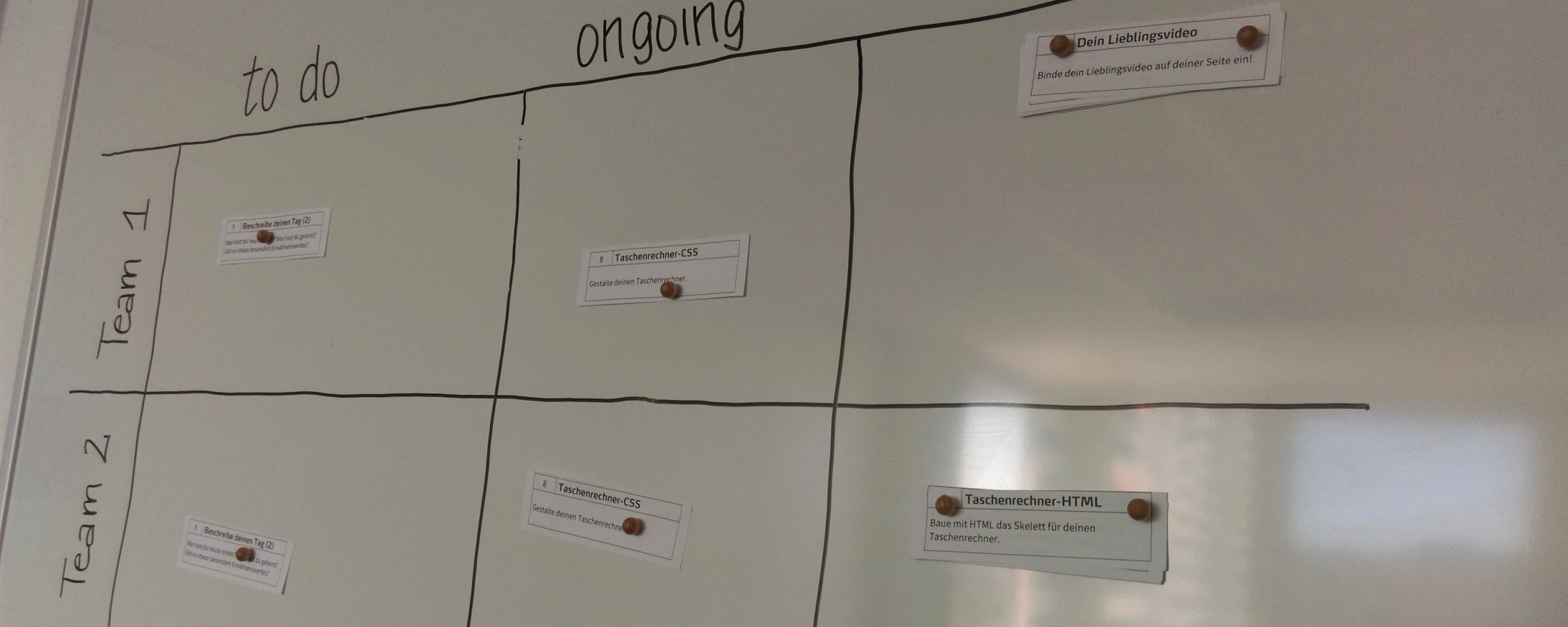
We also taught our three interns the basics of agile web development, because we believe this is the best approach for implementing more complex web projects. To that end, Anja, the Scrum Master for Team velo, led a short workshop with the interns. To convey the principles and routines of Scrum, we also started each day with a Daily Stand-up, did team exercises, and wrapped up the week with a retrospective. One insight from the retrospective: The idea of focusing on front-end technologies was a good one! One of our participants, in particular, was so impressed by the power and flexibility of these technologies that he can now imagine pursuing a career in web development instead of the hardware and network technology he had originally planned to focus on.
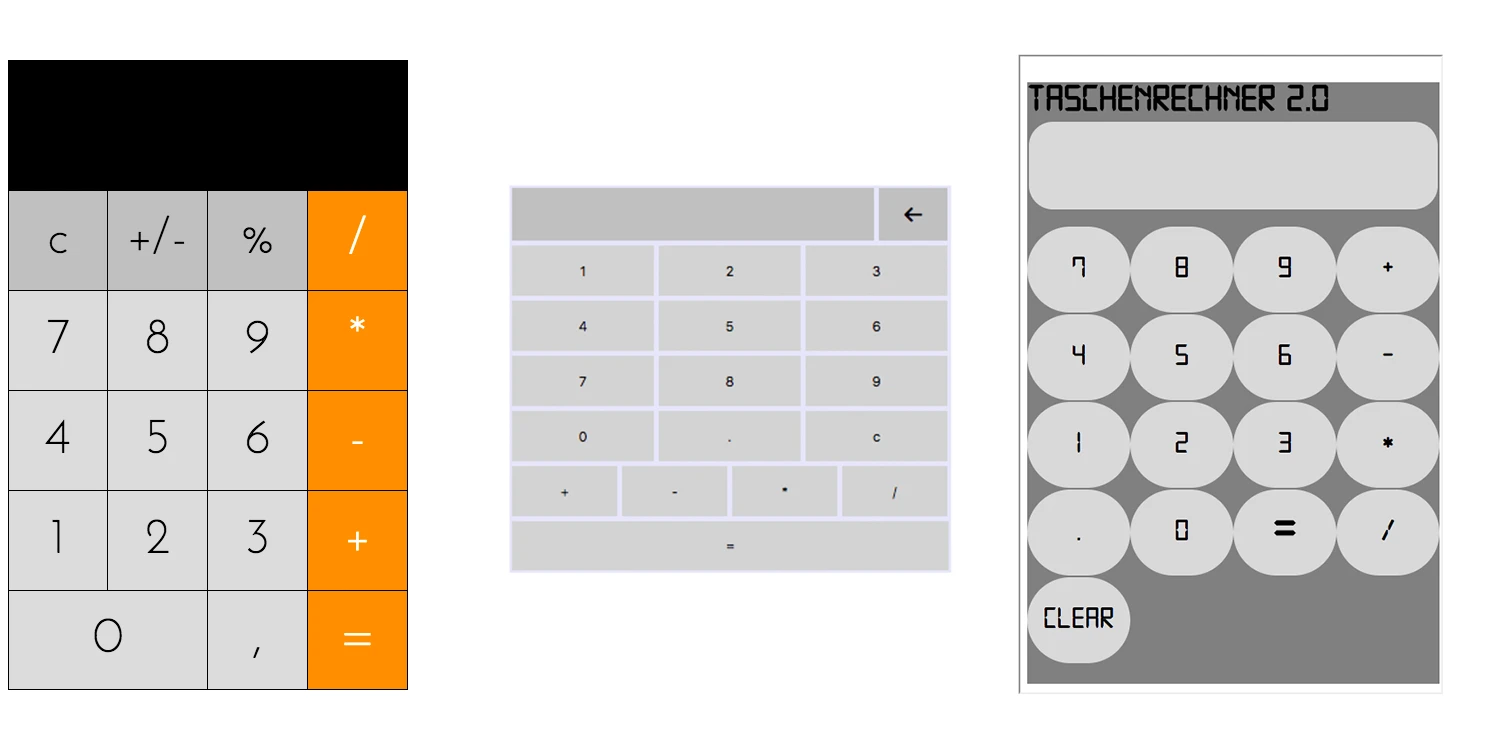
The calculator that our informatikBOGY interns had started developing on their first day at KIT was completely reworked and functionally enhanced while they were with us. What started as a very simple interface capable of adding only two numbers together evolved into a small calculator that supports point-before-comma arithmetic and can compute terms of any length. In addition, the user experience was redesigned so that certain input errors were caught and visually corrected until the interns were satisfied with the results. For example, Jan recreated the iPhone calculator:
We also let the interns experiment with APIs (interfaces). The result: we were able to embed random cat pictures on web pages. The goal here was to teach the interns how to familiarize themselves with technical documentation so they could independently address questions that arose and retrieve and use data. The advantage of this task was that it allowed the interns to develop their skills in a very personalized way. Those who preferred to experiment with design were able to do so. Others were able to focus more on more complex functionality. Either way, they received help when they had questions. A developer’s day-to-day work largely consists of dealing with emerging issues and solving problems creatively.
Damian and I had a lot of fun organizing and supervising the interns. After all, we were dealing with smart and bright young people who approached everything with curiosity and an open mind. I also enjoyed preparing for this new task, even though it was a challenge. It was very difficult for me to gauge what knowledge and skills the students would bring with them. And as it turned out, I had underestimated the interns. They brought far more to the table than I would have thought. Without further ado, we scrapped the original curriculum and dynamically developed a new one.
We hope that Julia, Jan, and Pascal had just as much fun as we did. And if we’ve helped spark a new career interest in them or reaffirmed their existing one, that would make us even happier. And yes, we’d love to be back next year!