Cancel
Start searching

This search is based on elasticsearch and can look through several thousand pages in miliseconds.
Learn more

Together with my colleagues from punkt.de —Weiye and Joachim—and our two core developers, Daniel and Sebastian, I attended the Neos Sprint at sitegeist in Hamburg at the end of March. For Joachim, Weiye, and me, it was our first code sprint, and we were very curious to see how the Neos team organizes itself and how we could contribute to the project.
Feeling a bit self-conscious at first, the three of us newcomers tried to find our footing. Where can we find work to do? Where are we needed? Is there a list of tasks we can look at? Do I even have the skills to tackle any of these tasks?
The personal warmth and approachability of the core developers quickly lowered our inhibitions about asking supposedly “stupid” questions—and each of us found an issue on GitHub that we could try our hand at. In most cases, the right Core contact person naturally emerged from the task itself. While Joachim and Weiye were working onNeos, I took on a task fromFlow, the framework that Neos is built on.
Basic questions about contributing to projects are explained in detail onneos.io. If you still have questions, theNeos Slackis a good place to start.
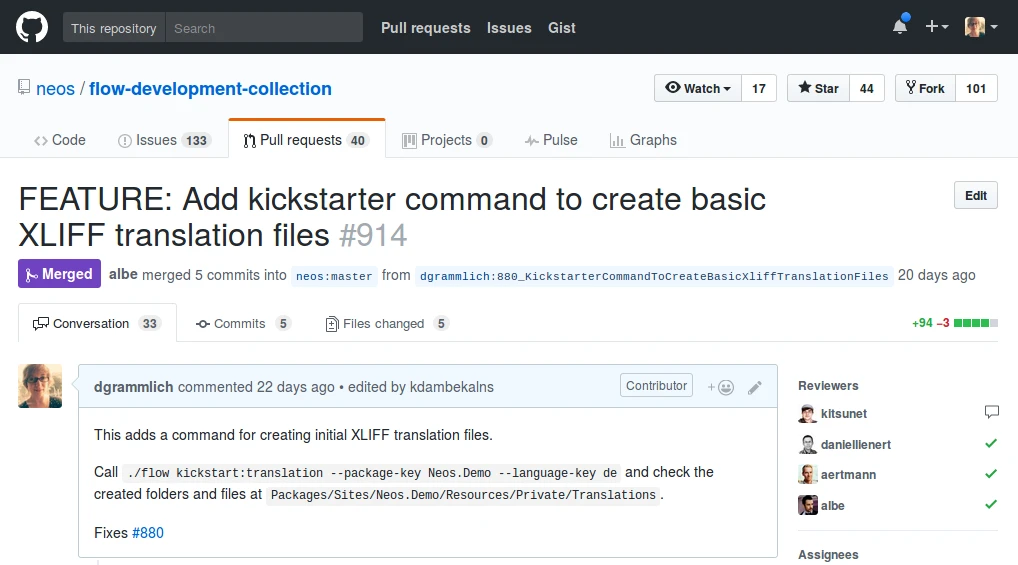
Before long, we had active pull requests on GitHub, where we discussed our implementations with the core developers—both on-site and in other parts of the world. Through this collaboration, we learned the pull request workflow and were often called out—more often than we would have liked—by the review tools that check code style and run tests.
The thrill of seeing all the tests turn green and getting the green light from the core developers involved in the review made it all the more rewarding. After that, the pressure of hitting the button that merged our implementation into the project left us exhausted but proud and highly motivated as we exited the pull request. We didn’t allow ourselves much of a break, though—we immediately dove into the next task.
Pending tasks and issues are documented in the issue trackers for Neos and Flow.
An introduction to pull requests can be found in the GitHub documentation.
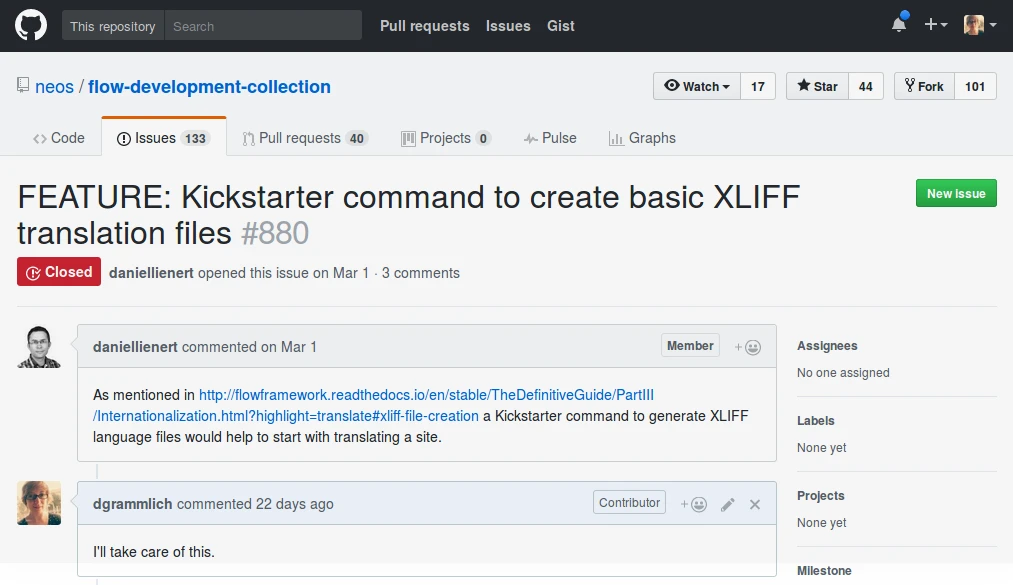
I am particularly proud of thefeature I was able to implement for the Flow framework. It allows package developers to generate translation files in XLIFF format for any language. If an XLIFF file with labels for the default language already exists, the translation files for the new languages are automatically populated with the existing labels, so that the developer only needs to enter the translations.
Shortly before the Neos Sprint, Joachim developed a Vagrant box based on the punkt.de-proServer, in which the Neos development project is loaded when the box is started. This box served as the foundation for Joachim, Weiye, and me during the sprint, and is freely available to any motivated contributor.
Our Vagrant box, based on the punkt.de-proServer, provides an easy-to-install development environment.
To use the box, you must have Vagrant and VirtualBox installed.