Cancel
Start searching

This search is based on elasticsearch and can look through several thousand pages in miliseconds.
Learn more
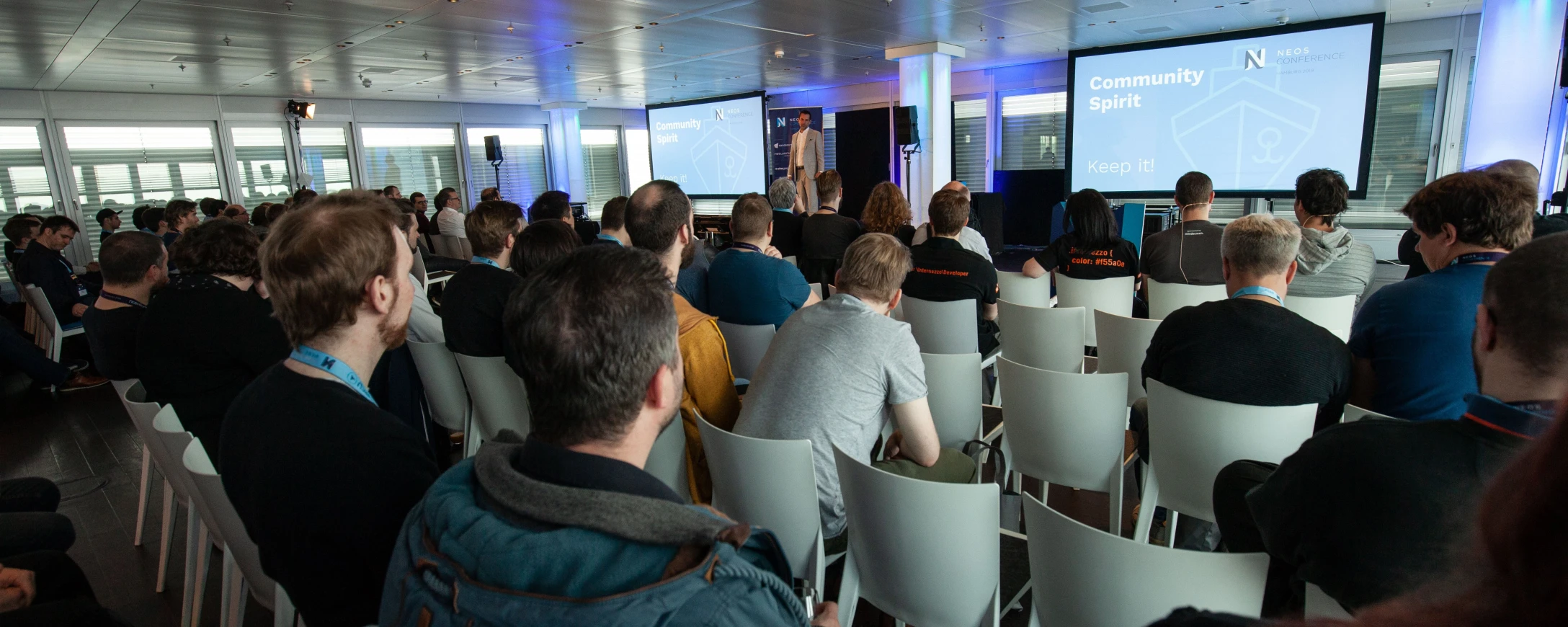
As a newcomer to the Neos scene, I was especially excited to attend NeosCon, which took place in Hamburg for the second time in 2018.
My first interaction with the Neos community was the warm-up event at the Bricks Tea Lounge and Bar, where the NeosCon organizing team from sitegeist . As soon as I walked into the bar, I noticed the great vibe among the attendees: People were gathering here in a relaxed atmosphere, looking forward to spending the next few days together to talk about Neos and help drive this vibrant project forward. As a newcomer, I was welcomed and accepted just as warmly as the participants who were already familiar with the event.
On Friday morning, we headed to this year’s venue, the Nord-Event Panorama Deck on the 23rd floor of the Scandic Emporio. We were greeted by Sven Ditz, the CEO of sitegeist and moderator of the conference, with the confident statement: “This location shows where Neos has come to be—right at the top.”
To be honest, this statement struck me as somewhat provocative at first. But the hours and days that followed showed me what the Neos community’s goal is: to offer the best a content management system can provide, without becoming aloof or looking down on other projects. The confident opening remark was intended to motivate us to foster precisely this spirit.
Guten Morgen Hamburg #Neoscon @neoscms @punkt_de @punktdehosting pic.twitter.com/lE8Yl73L9m
— Lars Liedtke (@CorvanCrowing) 13. April 2018
During the talk “The Perfect Neos Project Setup,” Karsten Dambekalns was preaching to the choir. Despite his love for vi and Emacs , he argued that developers should use a fully featured IDE instead of simple text editors—because IDEs help you get and maintain an overview of more complex projects like Neos and the Flow framework :) Tools like code completion and code inspection are further arguments in favor of IDEs.
He also strongly advocated for the use of source code version control systems like Git and automated testing. Of course, he also acknowledged that these techniques have been around for quite some time. But as long as there are still developers who copy file trees for version control, he believes we must never tire of pointing this out again and again.
My “ punkt.de ” colleague Daniel Lienert presented a case study on a project his team—with him serving as Scrum Master—carried out for the publisher Versicherungswirtschaft (VVW): the digitization of texts as part of a new publishing strategy. The texts are imported into Neos in the DITA source format using a custom-developed import plugin and are then available in Neos as articles—as if they had been entered directly there. In Neos, they can then be further edited and formatted as needed. The articles can now be exported to various output formats, such as website articles, e-books, magazine articles, and book templates.
The website articles are published directly on the publisher’s website, while the e-books can be integrated into the online store and made available for sale. If the texts are to be printed as magazine articles or books, they can be exported directly to Adobe InDesign for final typesetting. Of course, the existing formatting is taken into account during this process. The fact that approximately 400,000 Neos nodes are already being managed—with the goal of increasing this number to up to 2,000,000 Neos nodes—drew a round of applause. Neos nodes are text elements such as headings, paragraphs, and graphics.
At the end of the conference, a total of six Neos Awards were presented—bronze, silver, and gold, as well as three additional “Excellence Awards.” The jury consisted of Andreas Förthner, Aske Ertmann, and Gerhard Boden, who were selected based on their active and long-standing involvement in the Neos community.
Other winning projects:
Excellence Awards
Bronze: The Neos Award in the Bronze category went to a team from Sitegeist, which developed the website for Canusa Touristik, a travel agency specializing in Canada and the United States of America.
Silver: The Neos Award in the Silver category went to wysiwyg* for Canyon Bicycles, a website with an online store for a bicycle manufacturer.
Afterward, Sven Ditz invited us to a social event at Hamburg’s Nochtwache club with the call to action “Dance agile, drink lean.” In addition to excellent versions of standard cocktails and long drinks, there were also original creations that were truly impressive to look at and taste great. This provided the perfect opportunity to get to know participants from other companies in a relaxed atmosphere, catch up with old acquaintances, and have a good time together. Here, too, I was struck by the strong sense of community within the Neos community, which made me feel as though I’d always been a part of it—even though this was pretty much my first time interacting with it.
Ein tolles Projekt mit einem tollen CMS für einen tollen Kunden.
— punkt.de GmbH (@punkt_de) 13. April 2018
Wir freuen uns sehr über den #NeosCMS Gold Award 2018 für unser Projekt mit unserem Kunden VVW. pic.twitter.com/Ln8y2uuVly
“One Neos—Many Websites” by my punkt.de colleague Sebastian Helzle was the first talk on the second day of the conference. In it, he demonstrated how it’s possible to host multiple websites on a single Neos instance. This not only saves editors time—since they only have to log in once—but also makes it very easy to cross-reference pages across the different websites. Additionally, the various websites can access the same set of plugins and media, making it possible to store the media in a central location—the content repository. This capability is extremely interesting to me because, until now, I’ve only worked with content management systems that could manage only one website per instance, requiring a separate user account for each website. This approach can be a major simplification, especially for agencies that create and host many small websites for smaller clients. Thanks to Neos’s permissions management, editors can still be granted access only to the sections they are responsible for.
Another talk that caught my interest was “Everything about Assets” by Neos founder and one of the managing directors of Flow Native: Robert Lemke. He discussed how they made it possible to connect the content repository in Neos with storage and media services. Using this integration interface, you can store images and other media in storage services such as Google Cloud or Amazon’s AWS and link the media to Neos. In addition, there are reportedly implementations of the interface that provide connections to stock photo services like Shutterstock, allowing editors to search the offerings of such services directly from within Neos and purchase the media immediately, without first having to go through the corresponding portals and manually add the data to the content repository.
Robert showed us live how this works: He took a photo of the audience with his smartphone and then uploaded it to a specific folder on Google. And voilà—it automatically appeared in his Neos instance. That was really impressive, especially because I can easily imagine that the integration of stock photo services could make life much easier for editors.
All of the conference talks were streamed live online. Recordings of the talks are available in a YouTube playlist and can be viewed at any time. All conference technology was provided by Sandstorm Media, and drawing on my own experience in event technology, I’d like to give them high praise for the professionalism with which they handled everything.
The second day of the conference came to a close in the late afternoon. Even though those nearly three days were quite exhausting, I have to say that I had a lot of fun and, as a newcomer, felt very comfortable and welcomed. I’m already looking forward to NeosCon 2019, when the conference will leave Hamburg and move on to Dresden, where it will be held at the Alter Schlachthof.