Cancel
Start searching

This search is based on elasticsearch and can look through several thousand pages in miliseconds.
Learn more

With over 159 features (readers might be wondering at this point why there weren’t 160 :-) ), this latest version of TYPO3 brings many improvements. Among other things, the following features are now available:
The presentation was marred by poor audio quality, so unfortunately it wasn’t possible to follow everything. All that’s left for me to do is encourage you to take a closer look at the new TYPO3 version and give it a try. It’s worth it!
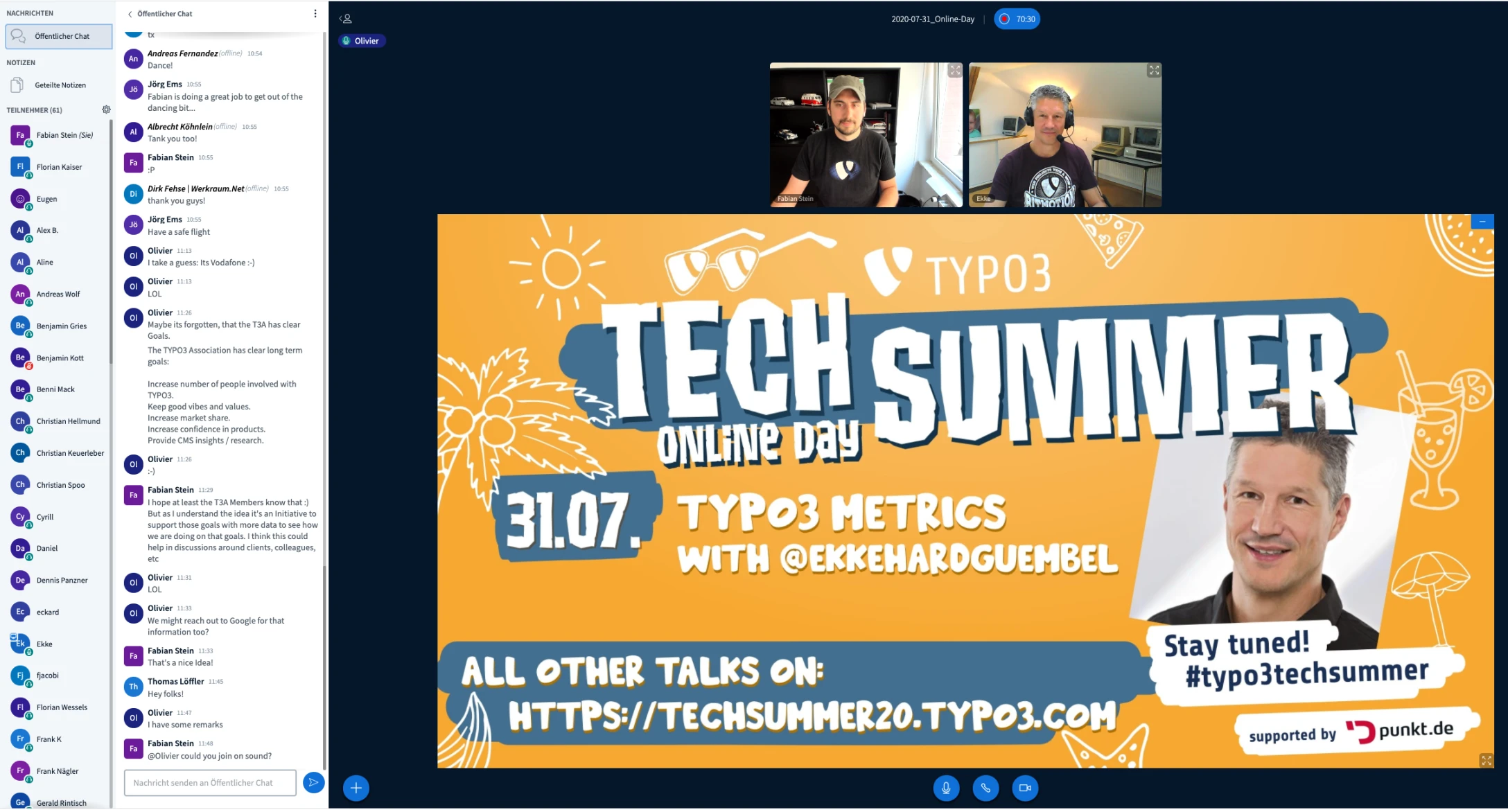
In his presentation, Ekkehard Gümbel will share data about TYPO3 and the community to provide insight into how TYPO3 is perceived and which metrics help the community further develop TYPO3. What trends are emerging in the market? Is it necessary to follow these trends? Which TYPO3 versions are still in use? These and other questions will be addressed. For more information, visit https://www.t3versions.com/.
The question of how “healthy” the TYPO3 community is can also be explored. All of these are important metrics that newcomers to TYPO3 can use to decide whether it’s really worth getting involved with TYPO3.
To this end, the TYPO3 Metrics Initiative was founded to address various aspects of data collection related to TYPO3. Ekkehard is still looking for volunteers who are knowledgeable in some of the relevant areas and would like to support him in this endeavor.
Anyone interested in getting involved can check out the #TYPO3-Metrics Slack channel to see and hear what’s going on. Don’t worry: this doesn’t mean you’re committing to participate just yet.
In the afternoon, the presentations became particularly interesting for TYPO3 developers and system administrators. It kicked off with the topic:
After a brief introduction, the presentation dove right into the nitty-gritty of the subject. Unlike other databases, Redis is fully optimized for speed. This is reflected, among other things, in the fact that Redis stores the entire database in RAM. It’s been a long time since I’ve heard a presentation where the speaker discussed CPU cycles and where the database documentation included O() notation alongside the commands—notation that indicates the computational cost of executing each command. This optimization for performance comes at the cost of a limited environment in which such a database can be deployed. Users are advised to read the Redis use case examples. As with anything that runs exclusively in RAM, it’s worth ensuring during setup that the amount of data held in RAM is kept to a minimum. Hashes are one approach that can be used to load the data to be displayed to users from slower storage.
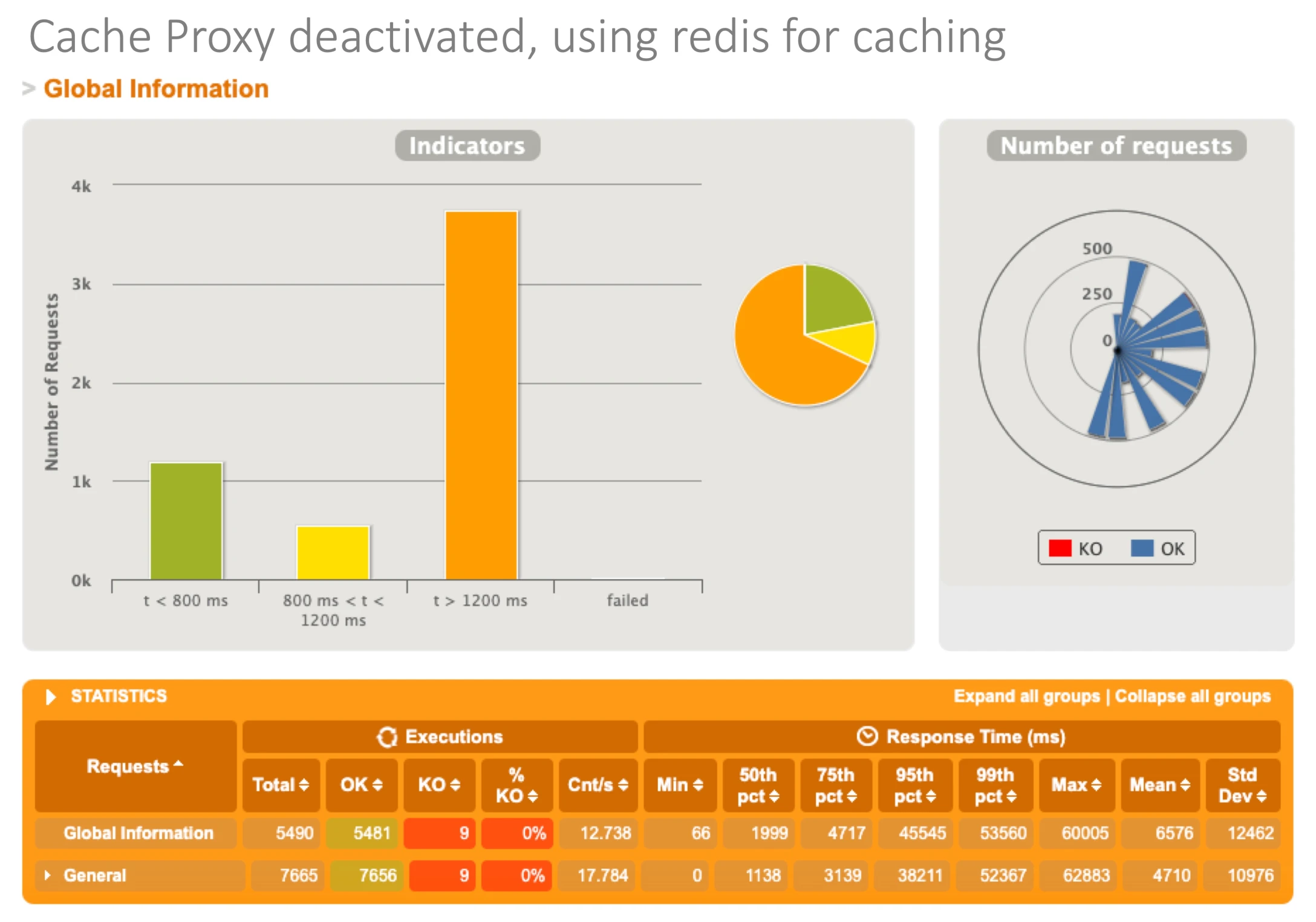
After an introduction to Redis, Christoph Zimmermann then presented the possibility of using Redis in a TYPO3 project. His benchmark configuration was TYPO3 10.4.4, Apache 2.3, and PHP 7.4.3 on a Dell XPS 13. Without any “black magic” or optimization, the test system was able to triple the number of requests handled with Redis. Of course, you’ll need to test this in your own setup to see if the speed gain is just as significant.
After Christoph Zimmermann introduced Redis, it was Daniel Lienert’s turn to present a real-world example. In a system we developed, we had to implement a very complex and extensive authorization scheme, which would have been impossible without Redis because the response times were simply too long. Daniel used Gatling in his benchmark to simulate realistic user behavior.
Since this is a truly easy-to-install “drop-in” replacement, Daniel suggested simply giving Redis a try in TYPO3 projects. The users of your website’s frontend will thank you for the speed boost.
In the following, Simon Praetorius (sitegeist media solutions) shares his experiences with the Living Styleguide used at sitegeist.
Everyone is familiar with the problem: at the start of a project, a style guide is agreed upon between the design agency and the client, but it then changes as the project progresses. How do you track all these changes and document them so that everyone involved in the project knows what the current status of the layout is?
Well, it’s actually quite simple:
Take: fluid-components (a TYPO3 extension) and then fluid-styleguide. With these two extensions, you can break down your layout into components and partials that you can then access in your projects. Partials are the smallest units that make up a layout. You can then use these partials in the components, which you can manage with “fluid-components.”
Fluid-Styleguide then helps present the components defined above as a “living” style guide. The extension makes all individual components visible in one place. This has the advantage that the style guide always matches what the developers are using in the project, since, technically speaking, it draws on the same data.
This has many advantages: Designers can see how the layouts have been implemented and can quickly coordinate with developers if the developers need a different implementation. For developers, the advantage is that the developed layout is always visible in one place. The style guide also helps developers create the corresponding components here, allowing them to reconsider individual components at a more abstract level. This makes it possible to standardize certain components, which not only simplifies development but also makes the front-end layout appear more consistent and cohesive. For testers, the advantage is that they can see all components in one place, allowing them to quickly assess whether all agreed-upon components have been implemented. For the project manager, the Living Style Guide offers the advantage of being able to quickly see which components have already been fully implemented and styled. Last but not least, the client can also see at a glance which content is being used in the project.
A Living Style Guide really gains momentum when it’s used to achieve the shortest possible release cycles for the layout as well. Instead of the usual waterfall model, Dan Mall proposes the “Hot Potato” process, in which individual pieces of content are passed from the designer to the developer as quickly as possible—like a hot potato—so the client can then approve the result.
In his presentation, Simon then demonstrated in a live demo how easy it is to implement a new client requirement using the Living Style Guide.
Michael Telgkamp’s presentation focused on how to make the TYPO3 Pagetree more accessible.
Michael is a member of the TYPO3 “Accessibility Initiative,” where he is actively working to make TYPO3 accessible to even more people.
In TYPO3 version 9, the entire TYPO3 Pagetree was still a single SVG file that could only be navigated with the mouse. At that time, TYPO3 was not at all accessible in this regard.
Michael had his first ideas for making the Pagetree accessible as early as 2019. He presented his ideas at various TYPO3 events, which led to his invitation to “TYPO3 Initiative Week.” Soon, the idea was born to implement the TYPO3 Pagetree using the W3C standards from the WAI-ARIA project.
The ideas presented there stipulate that all content must be directly accessible via the keyboard and must also be organized in a specific structure. However, the TYPO3 Pagetree’s structure at the time was anything but suitable for this. The elements, rendered as SVG, were not organized as a page tree in the data structure; not all elements were displayed—only the visible ones were present in the DOM element—and so on and so forth.
The challenge was to prepare the elements for the browser in such a way that it could respond to them appropriately. To do this, the elements had to be enriched. Michael took on this extensive and, at times, quite tedious process. Once the necessary tags were in place in the Pagetree, “all that remained” was to program the corresponding actions for the browser, and the Pagetree was ready for accessible use.
Once all that was done, Michael created the necessary tests to ensure that the Pagetree would remain accessible in future versions of TYPO3 as well.
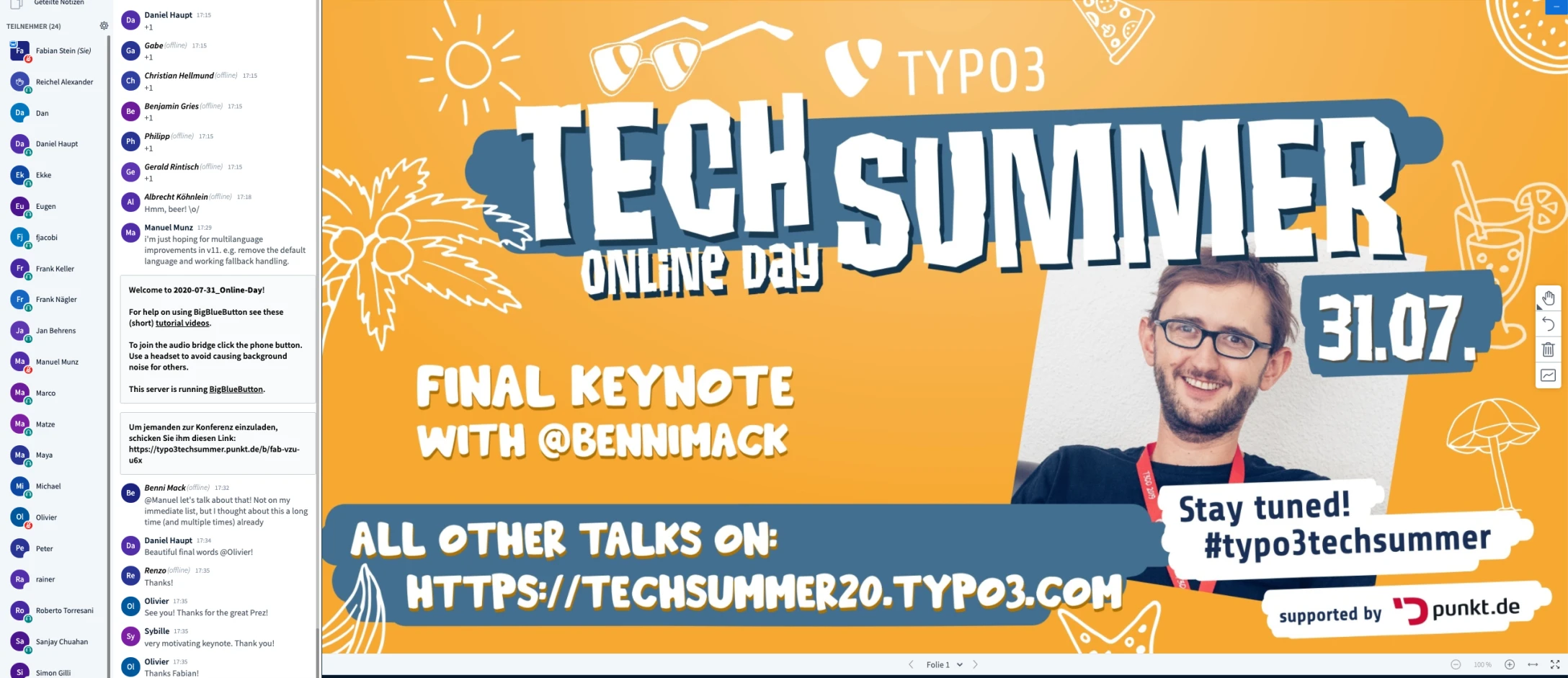
In his closing keynote, Benni shared his thoughts on TYPO3. In his opinion, recent versions of TYPO3 have been developed too much by developers for developers. As a result, too little attention was paid to features that would have been valuable to users.
With over 500,000 TYPO3 installations, it’s safe to assume there are more than a million users who use TYPO3 in Backend. Developers, on the other hand, number only a few tens of thousands. In this regard, it’s worth focusing more on the TYPO3 user base, which is 100 times larger.
Benni suggests that we leave the era of “Developer-Driven TYPO3” behind and, with TYPO3 Version 11, embark on a new path in which we place TYPO3 users at the center of our efforts.
To this end, Benni proposes the following approach for version 11:
At the end of his presentation, Benni advocated making TYPO3 a CMS for “everyone” and called on the community to rise to the new challenges.
All in all, the Techsummer Sessions were a successful event that continued the following weekend. Unfortunately, they cannot replace the in-person meeting in Karlsruhe. So we all hope that we can meet in Karlsruhe in 2021. We at the punkt.de look forward to hosting the TYPO3 Developer Days then.
Here are my slides from my @TYPO3 #TechSummer keynote from today https://t.co/anCSC7VyH8 pic.twitter.com/GbuK5Sl1DC
— benni. (@bennimack) July 31, 2020
Fantastic Talk @bennimack Very passionate and motivated presentation!
— Sanjay Chauhan (@sanjay_nitsan) July 31, 2020
I've seen different Benni (Mr #TYPO3 Entrepreneur😎) and Very eager to spread TYPO3 to the world. Let's keep working hard together for "TYPO3 CMS For Everyone." ♥️#T3Kudos and, Thanks to @punkt_de https://t.co/hYhV4LqeB2