Cancel
Start searching

This search is based on elasticsearch and can look through several thousand pages in miliseconds.
Learn more


Just as in the first weeks of the Covid-19-related lockdown, every video chat presented a small challenge (even if it was only that the author can now call a total of about nine video programs his own, and each one is a little different to use), we quickly got used to the inevitable and gradually wrested the positive sides of the new.
This effect was also evident at our second TYPO3 Techsummer event.
At the first Techsummer event, some speakers had minor problems, which we were able to resolve in advance with the speakers of the second round. This time, everything went as planned technically and we were able to concentrate on the event.
The first event had a few more listeners. We think that this was also due to "normality" and that the curiosity had faded a little. But we can assure all those who were not present: You missed some great presentations.
This headline from the last blog article could be recycled here and thus serves a little for the sustainability of this series of articles about the Techsummer.
But seriously: Christian Keuerleber drew attention to the need to deliver software that is as bug-free as possible in an entertaining way using "quirks" in computer games. With enough will, enthusiasm and know-how, you can easily break through seemingly solid walls in games and play through a game in 1.5 hours instead of a few days or weeks.
The scene that takes advantage of these bugs in games gathers on the Internet under the keyword "Games done quick". So https://gamesdo nequick.com/ is a good start to take a look at these interesting methods and learn from them.
While it can be "fun" to break the rules of a game in the truest sense of the word and achieve the impossible, web-based business applications are a little different. Any potential bug here can lead to material damage. We therefore recommend the Top Ten OWASP list to every reader, https://owasp.org/www-project-top-ten/, where the biggest mistakes to avoid are explained briefly and concisely.
Automated tests, which ensure that errors are automatically detected during development and thus avoided, are another building block. Of course, the prerequisite here is that you also look at the results of the tests and only take the software live when all the tests are green.
Here are the slide of my talk at #TYPO3TechSummer https://t.co/5iwaCrTetx #TYPO3
— Kabarakh (@kabarakh) June 25, 2020
... to better manage your data in TYPO3 was then presented by Alexander Böhm.
TYPO3 comes with a predefined set of page types, but you can also customize them according to your wishes. The advantage of this is that it is easier for editors to manage the content in a structured way later on. The advantage of structured content is that it can be much better optimized for SEO and that you also have the opportunity to output the content differently later on based on its structure.
It makes a difference whether something is marked "red" or whether "red" has a negative signal effect in a specific project. This small but subtle difference can lead to major problems for software that is later to be used in China if it cannot be automatically redesigned due to an unstructured presentation of the content.
However, the use of several new page types can also lead to problems, e.g. there are more pages in the page tree for which a sorting strategy is required.
The agency of your choice should be able to help you make a decision.
Here are the slides @dark_iguana_85 used for his talk at the #TYPO3TechSummer https://t.co/vnUKff5xeP #typo3
— punkt.de GmbH (@punkt_de) June 25, 2020
in the new TYPO3 book, which was presented by Voker Neuenhaus & Frank Schubert.
The book will be published by Apress. The planned completion date is July 2020 and the book will be published in the third quarter of 2020.
You can find out more on the project website: https://www.typo3book.com/
Sorry for the Germanization, but I wanted to see if the term "dashboard" could be translated. In my opinion, it doesn't work in this particular case.
Richard presented the results of the TYPO3 Dashboard Initiative(https://typo3.org/community/teams/typo3-development/initiatives/typo3-dashboard-initiative). As lead developer, he gave deep insights into the project, and you could quickly see how you can use the dashboard in your own TYPO3 projects.
Since there are already many ready-made widgets that only need to be configured, it is quite easy to get started. Backend programmers have the opportunity to write their own new dashboard functionalities. This gives you more freedom in terms of design, but a dashboard like this in the backend depends on the uniformity of operation. Imagine a dashboard in red with a glittering pink clock. That doesn't work, so you should hold back in terms of graphic self-realization.
These self-programmed widgets are also easy to integrate for developers with experience. The dashboard team is happy about every new dashboard that is made publicly available by this site.
Anyone who has ideas for new widgets is encouraged by Richard to share them with the team. Even if you can't program these widgets yourself, you may be lucky enough to find a developer who also finds the idea interesting and perhaps gets to work on it.
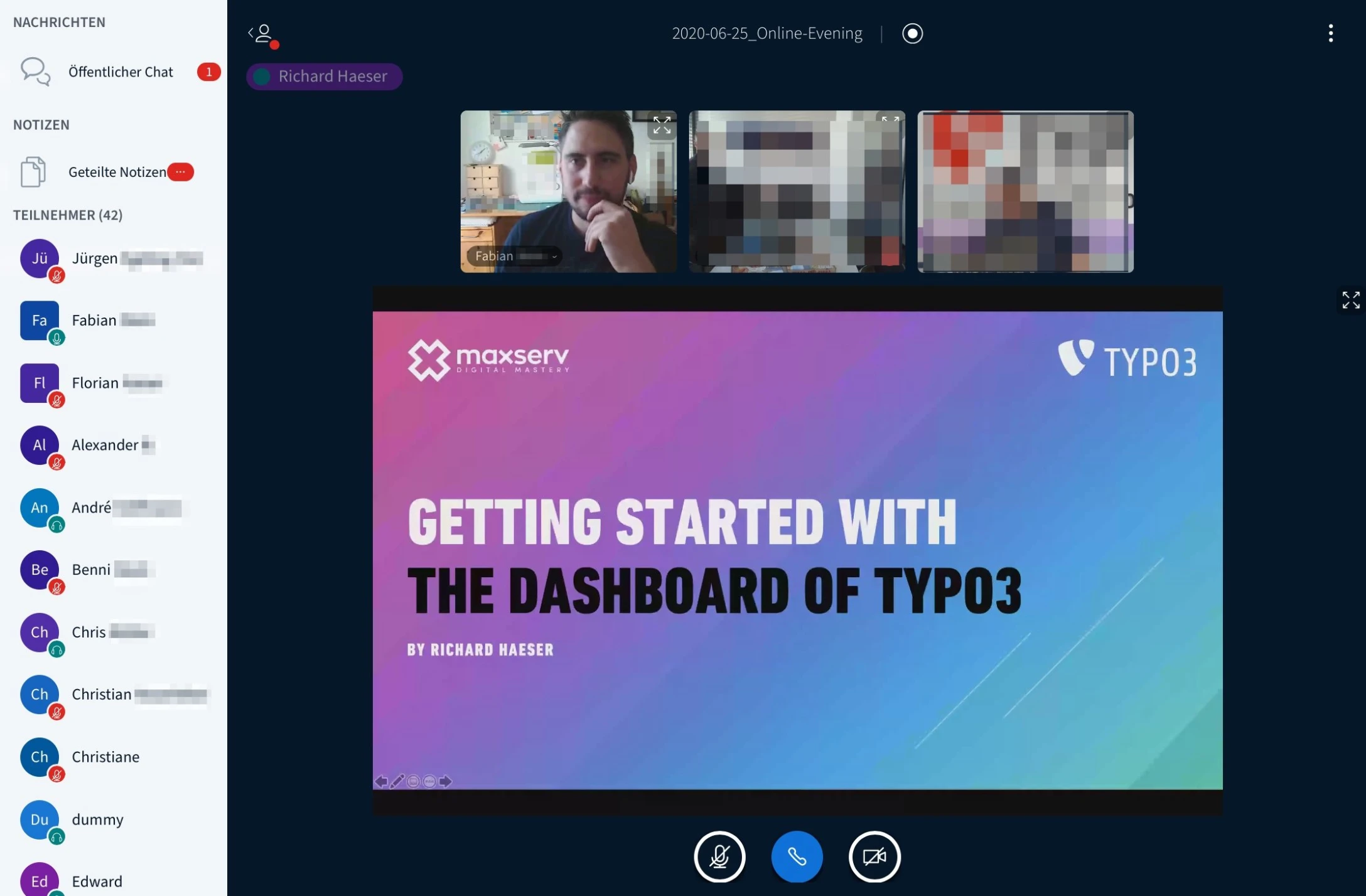
The event went well, and was transformed from an exotic to a "normal one"
(https://www.youtube.com/watch?v=o2WKnAIYELo) Congratulations and thanks from this point to all those who contributed to its success.
The next normal TYPO3 Techsummer event will take place online again in these unusual times. It would be nice if the reader who has read this far marks July 17, 2020 completely in the calendar, because this time from 9:00 a.m. with smaller breaks many interesting lectures are waiting for a larger audience.
You can find more information here: https://techsummer20.typo3.com/events