In a world where information is overwhelming and a company’s digital presence is critical to its success, the ability to find relevant content quickly and efficiently is becoming increasingly important. At punkt.de, we’ve recognized this challenge and specialize in developing advanced search solutions that help our clients achieve exactly that. With extensive experience in Elasticsearch and Solr technologies, we offer a customized search solution that goes far beyond the conventional.
The available search functions
Our standard search solutions offer comprehensive indexing of all content types—from articles and pages to events. We go one step further by enabling the indexing of file attachments with full-text search, including documents and PDFs, to ensure that no detail is overlooked.
However, we understand that every website is unique and requires customized solutions. That’s why we discuss advanced features with our clients, such as:
- Different result sorting options: We offer flexible sorting options to tailor the search to users’ specific needs. Events, for example, should be sortable chronologically in addition to being sorted by relevance to the search parameters. This ensures that the most relevant and upcoming events always appear at the top of the search results.
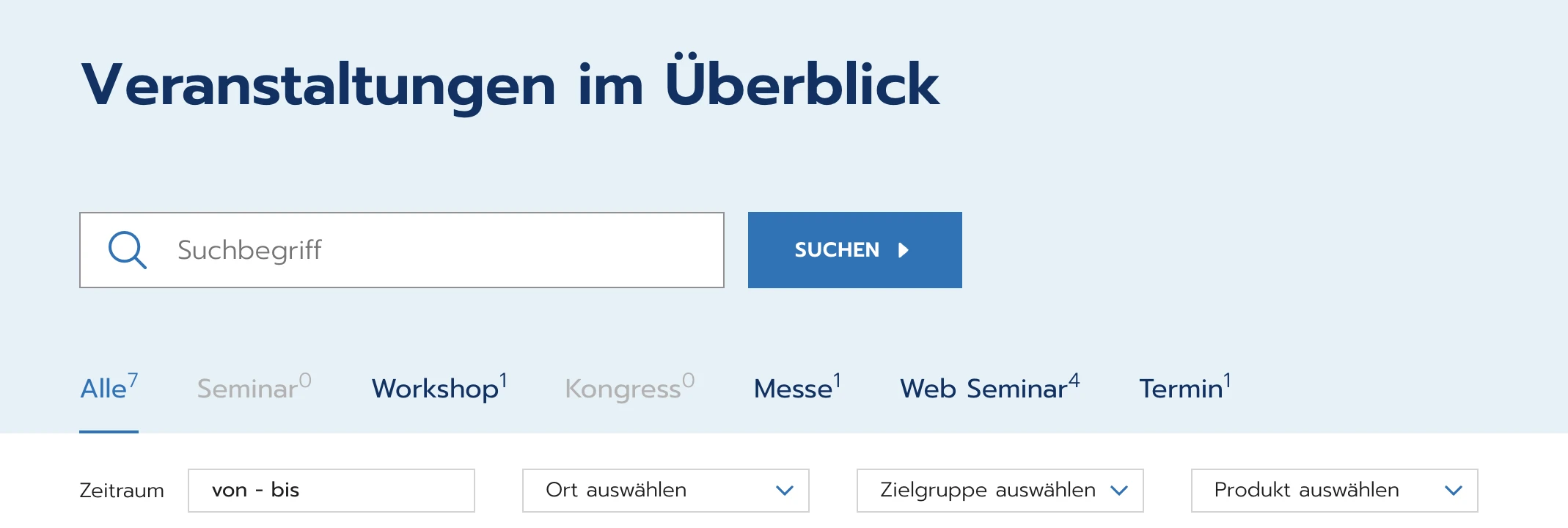
- List view within the project based on the search index: An optimized list view, such as the one seen on the CGM event overview page, makes it easier for users to find relevant information.
- Various filtering options: Whether by date, taxonomy, or content type—our search solutions offer a wide range of filtering options to refine the search.
In addition, the following features significantly improve the search experience:
- Autocomplete: As users type in a search term, relevant search suggestions are displayed to save them the trouble of typing out the entire search term.
- Search Suggestions: As users type their search term, relevant search results are displayed to help them find what they’re looking for more efficiently.
- Search Expansion: Similar termsrelated to the current search terms are displayed, which can positively influence the search results.
- Blocklist: This feature allows certain search results to be excluded so they are no longer displayed to visitors.
- Fuzzy Search: The feature best known as “Did you mean…?” for correcting typos and finding similarly spelled words
- Cross-Source Search: For projects that span multiple instances and portals, it must be clarified in which search context results should be found.
- Domain-Specific Search: The search index is enriched with data from various domains and subdomains so that the search can also find cross-project results.
- Visitor tracking: Based on the search terms used by users, the search is fed with additional data. This allows search results to be tailored even more specifically to visitors’ habits.
The data can also be enriched with additional information in the presentation of search results. The following options further enhance the quality of the search:
- Call to action directly from the search results
- Additional information such as contact details, addresses, etc.
- Display of the taxonomies used in the search result dataset
Search from the Product Owner's Perspective
Product owners play a key role in developing an effective search solution. On the one hand, they must work with the development team to make the technical decision between SOLR and Elasticsearch; on the other hand, understanding existing components and configurations, as well as managing the budget, are crucial to the project’s success.
Search is therefore always a collaborative effort involving everyone on the project team and all stakeholders. The following challenges and solutions can be identified:
- Development Process: Integrating search functionality at the end of the project may seem logical at first—since all content types are available by then—but it can also lead to unnecessary complications. Incorporating search earlier in the development process allows the architecture to be planned around search requirements from the very beginning.
- Expectation Management: Helping customers adjust to Google-like search experiences can be a challenge. Early discussions about search functions and active expectation management are essential.
- Content Quality: Search quality also depends significantly on the quality of the content. An ongoing dialogue with the client about optimizing and prioritizing search results helps to continuously improve the search experience.
Get started with your own search feature today
Search functions on websites are more than just a text box; they are at the heart of the user experience and a crucial factor in the success of your digital presence. At punkt.de, we strive to develop search solutions that are not only efficient but also intuitive and adaptable. If you’re ready to take your search capabilities to the next level, contact us at kaffee@punkt.de.
Whether you want to optimize your existing search or develop a completely new search solution, our team is ready to help make your vision a reality.
More in-depth searches on punkt.de