Cancel
Start searching

This search is based on elasticsearch and can look through several thousand pages in miliseconds.
Learn more
For us, data sovereignty isn’t just a buzzword—it’s a philosophy we put into practice in all our projects. It’s the foundation that enables companies to manage their processes independently, expand them over the long term, and adapt them flexibly—without getting themselves into costly dependencies.
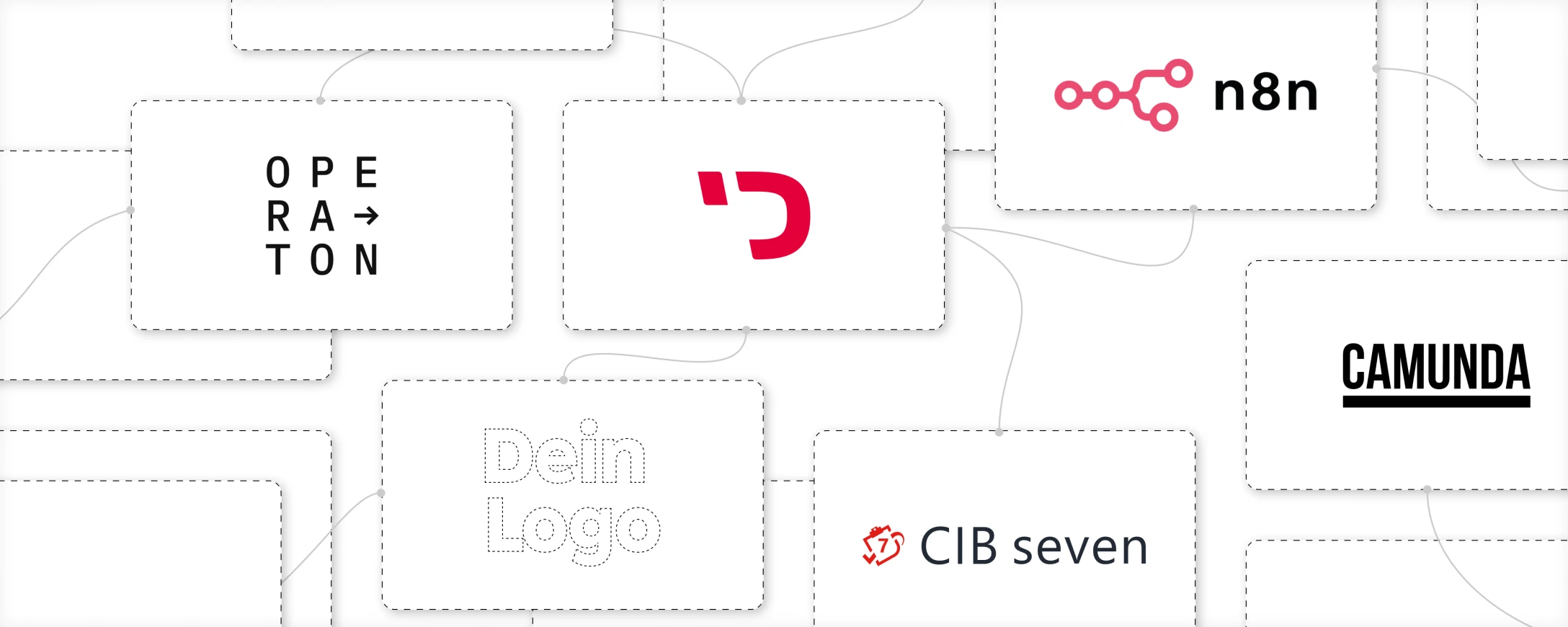
Terms like Camunda and n8n refer to process and automation tools that help companies manage workflows not manually or through custom scripts, but rather through graphical models and reusable building blocks.
Such tools offer several advantages:
This greatly lowers the barrier to entry for automation: business units can actively participate in the design process, while developers focus on the truly complex parts. And it is precisely at this intersection—between business processes and technical implementation—that we at punkt.de bring our expertise to bear.
For large-scale, long-term processes, we rely on Camunda 7 forks (Operation, CIB Seven). They enable us to implement enterprise-level automation in an open-source environment —stable, extensible, and without licensing restrictions. This allows us to offer our customers a solution that can be supported over the long term without them having to relinquish control. This approach is ideal, especially for highly complex scenarios where reliability and compliance with standards are critical.
At the same time, we use n8n for lean and flexible workflows. This Berlin-based tool allows us to run automations in-house, extend them ourselves, and host them entirely internally—unlike many other SaaS/cloud solutions. This enables us to implement even smaller and more agile automations—without transferring data to external platforms.
Another advantage: n8n has an active community that’s constantly developing new integrations. This makes it quick and easy to integrate the latest tools and services, while keeping data under our own control at all times.
Our collaboration with our friends at KEMBis particularly exciting. They are successfully using n8n in the areas of business intelligence and lead management. Our automation projects complement their expertise perfectly: While we map out processes from a technical perspective and integrate complex systems, KEMB contributes valuable know-how in data analysis and marketing. Together, we can offer our customers an end-to-end automation stack that ensures data sovereignty.
Automation is not an end in itself—it only realizes its full value once processes are truly understood and clearly modeled. This is exactly where we come in:
In this way, we ensure that automation not only works technically but also delivers strategic value.
Automation is possible everywhere—the only question is: How much control will you retain in the process? Our approach at punkt.de is clear: We rely on open source, transparency, and solutions that ensure your long-term independence. Whether using Camunda 7 forks for complex processes or n8n for flexible workflows—we offer the right tools and the expertise to automate processes sustainably.
And best of all: No matter what you decide, we support both approaches—and, if needed, we also develop hybrid solutions that combine the best of both worlds.