Cancel
Start searching

This search is based on elasticsearch and can look through several thousand pages in miliseconds.
Learn more

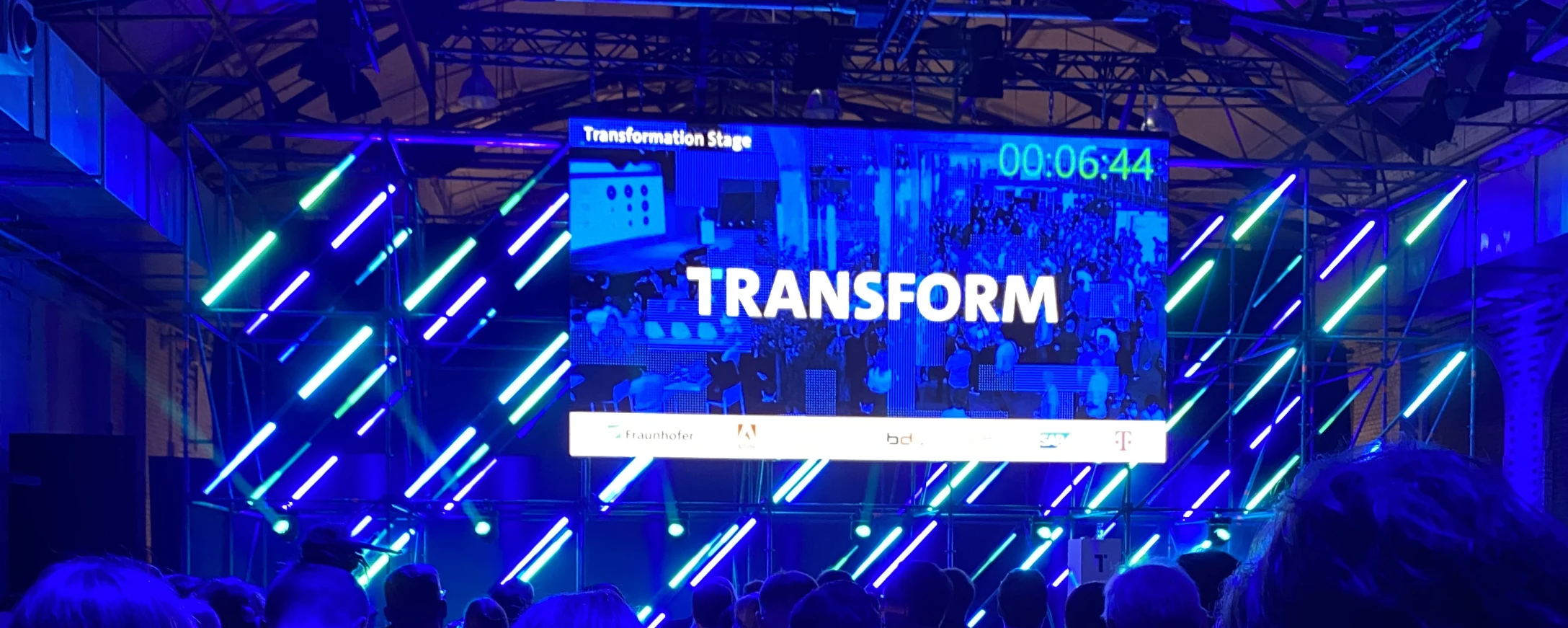
The dominant topic at TRANSFORM was, of course, artificial intelligence (AI). From the practical use of AI to the ethical, political and legal framework conditions, there was a lot of discussion and presentations in various formats.
In the week before TRANSFORM, I had already organized the "AI Discovery Day" with my colleagues in Düsseldorf at TYPO3 GmbH, where we exchanged ideas with various agencies on the topic of AI, and now I visited the company side at TRANSFORM.
With the topics from our exchange with the agencies in my luggage, the Bitkom TRANSFORM was doubly interesting.
Above all, there were some similarities in the assessment of the current AI situation in Germany and Europe and the rapid pace of change that is hitting us with full force.
A lot of homework that was not done in the past, both by politicians and companies, is now coming back to haunt us. Very practical problems such as the sluggish expansion of the network and the lack of digitalization in public administration and the private sector are hurdles that still need to be overcome.
As our Minister of Justice, Dr. Marco Buschmann, explained in his keynote speech using the example of the e-file, reducing bureaucracy is difficult and the benefits of AI cannot be used for public administration if the relevant data for training the models is still only available on paper.
The starting signal was given in 2013 with the E-Government Act (EGovG), the contract for the federal e-file was then awarded in 2017 and little has happened to date and it is hoped that the e-file will be the new standard by 2025/2026. Until then, AI can only relieve the burden on public administration to a limited extent, which is a real locational disadvantage in Germany in times of a shortage of skilled workers and long procedures in the authorities. Aspirations and reality could not be further apart.
In the private sector, there is reason to hope that Europe can free itself from the dominance of American and Chinese companies. With Aleph Alpha and Mistral AI, there are two beacons of hope. However, there is no guarantee that the gap can be closed. As Jonas Adrulis (CEO, Aleph Alpha) emphasized at TRANSFORM, the balance of power is still too uneven.
He pointed out that the enormous sums mentioned in the press for American AI companies are only a fraction of what companies such as Google or Microsoft are actually investing. It remains a challenge to mobilize similar amounts of investment in Germany and Europe in order to promote European models. Everyone at TRANSFORM agrees that a European model is more important than ever.
Many companies have recognized the potential of AI for themselves. German companies are already using AI in a variety of ways, as Marianne Stroehmann (Managing Director Enterprise & Site Lead Hamburg, Google) explained in her presentation. According to a study commissioned by Google, German companies are currently using AI in the following areas in particular:
Numerous use cases for AI and AI-based solutions were presented at TRANSFORM. It is important to overcome reservations and quickly adapt the new technology in order to keep up with the competition from abroad in the future.
Whether it is T-Systems, which is using AI to drive forward the expansion of fibre optics in Germany, SAP with its own AI assistant that optimizes processes within the SAP ecosystem or the many small start-ups with many innovative ideas that were able to present themselves at TRANSFORM, all of this shows that AI has incredible potential for companies. The prerequisite is that German companies continue to digitalize in order to exploit the potential of AI for themselves.
It is precisely this point that brings us back into play as punkt.de GmbH: the digitalization of SMEs and large companies is more important than ever. For companies to be able to use AI, they need the relevant data to train their models. Of course, this change is not only taking place on the customer side; we as an agency are already changing too.
Over the past two weeks, the AI Discovery Day and TRANSFORM have given me an overview of the changes taking place on our agency side and on the client side and where the journey is currently heading. I am curious to see how this blog post will age and whether I will still have the same optimism about AI in 1-2 years' time as I do today.