Cancel
Start searching

This search is based on elasticsearch and can look through several thousand pages in miliseconds.
Learn more
1 million page views—no problem.
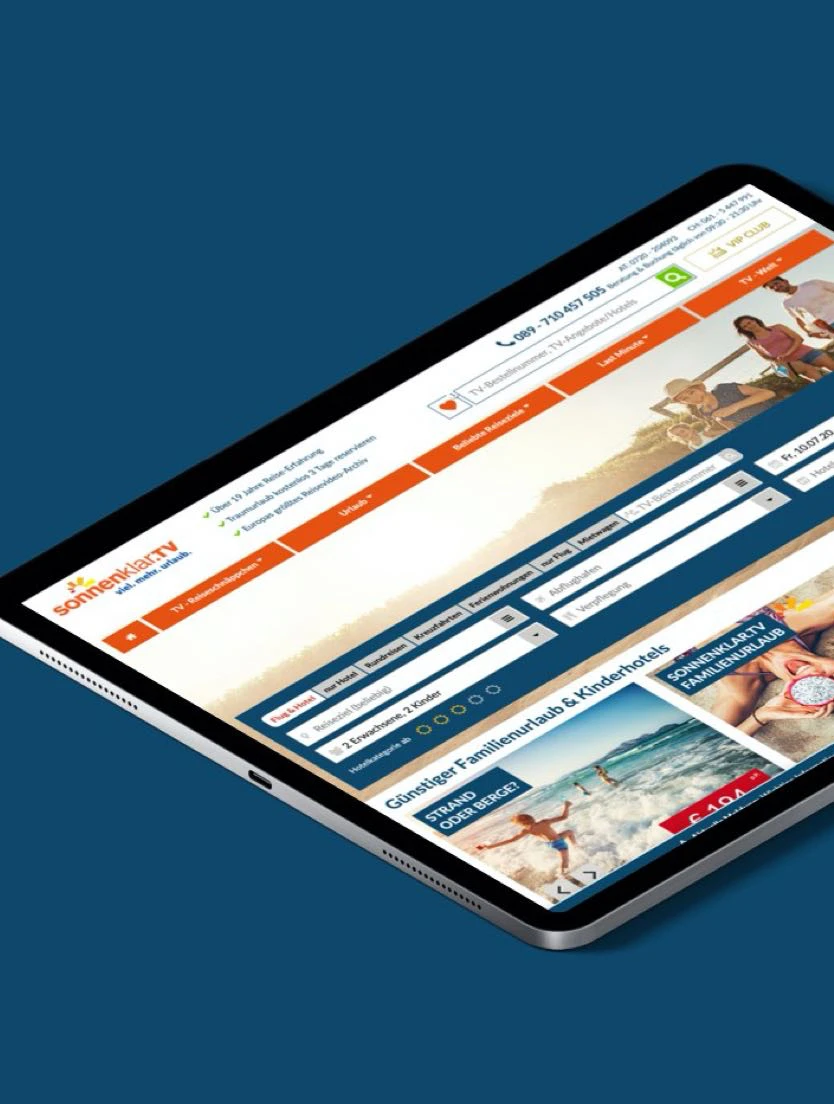
In the first joint project between FTI and punkt.de, the relaunch of sonnenklar.tv was to be based on TYPO3. FTI received a recommendation for punkt.de: “If anyone can pull this off, it’s them!”
FTI Frosch Touristik GmbH operates sonnenklar.tv, a travel home-shopping channel. Its total technical reach is 31.8 million television households. Of these, sonnenklar.tv reaches 18.8 million households via satellite and 12.9 million via cable. Additional programming slots on private television stations further expand its reach.
Everyone should know about the added value of punkt.de —they're the jack-of-all-trades!
sonnenklar.tv broadcasts more than 40 hours of live programming per week. The programming is available 24 hours a day on its own channel via cable and satellite and is also offered as a live stream on the Internet. The offerings range from package tours and round-trip tours to last-minute trips, as well as scheduled and charter flights.
Sonnenklar.tv employs a so-called multi-channel strategy, in which trips are offered not only through TV, call centers, and sonnenklar.tv travel agencies, but also online at www.sonnenklar.tv. During peak times, sonnenklar.tv reaches 1 million page impressions, particularly during broadcast times on weekends and holidays.
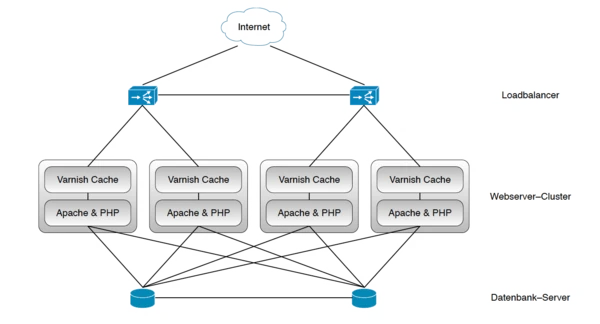
Due to the high volume of visitors, a single server can quickly reach its limits. punkt.de has used load balancers to distribute the traffic evenly across multiple servers (clustering).
TYPO3 is designed so that every user request is served from a central database. Given the traffic volume on sonnenklar.tv, the response time for such a request is simply too long, even with high-end hardware.
A cluster complicates development work with TYPO3. Access to the central database and the storage of data in files must be eliminated as much as possible. In addition, the content is constantly updated in parallel with the live television broadcast.
Requests are served from a cache whenever possible. This cache is run on each individual front-end web server to ensure good scalability by adding additional cluster servers. Ultimately, the system serves most requests directly from memory without having to access the database, which is a slower process.
There were no predefined architectural requirements; we simply explained how we wanted to work, and punkt.de far exceeded our expectations in bringing our vision to life.
“That was impressive: Even during our very first meeting, punkt.de understood exactly what we needed. In some respects, they even exceeded our expectations.”
The system’s throughput and scalability were achieved through clusters in a TYPO3 environment as follows:
Backending takes place on a single editorial server. Thanks to the shared database, all content stored there is immediately accessible from all front-end servers.
Data in the file system is replicated from the editorial server to all other servers using rsync. Since the customer was perfectly comfortable with an update interval of just a few minutes, the decision was made to forego setting up a central storage system and the associated complexity and susceptibility to errors.
At punkt.de, “24/7” means more than just 24/7. We even received support on holidays and for parts of our application that weren’t designed or operated by punkt.de.
Clustering in the TYPO3 environment is challenging for any software developer because standards-compliant programming is not possible. This creates sources of error that are difficult to trace. In some cases, existing solutions can no longer be relied upon, and in-house developments are indispensable in many areas.
punkt.de was able to fully meet the corporate requirements and ensure cross-platform synergies for FTI, which also works with TYPO3 solutions.
Our collaboration with Mr. Hausen, a network engineer at punkt.de, was exceptional. No one else could have put together a comparable concept with a cluster solution so quickly and precisely—this is a first in the TYPO3 community! punkt.de stands out for its fair scope of work and pricing policy. We now have an online shopping solution whose value for money far exceeds that of our previous one.